
What $930 Billion in Data Center Spending Really means
Did you know that over the last six years, spending on data centers has reached an estimated $930 billion? That's a number worth pausing on. Here's what it means, why it matters to you, and what to be aware of if you run a business.
Putting $930 Billion in Perspective
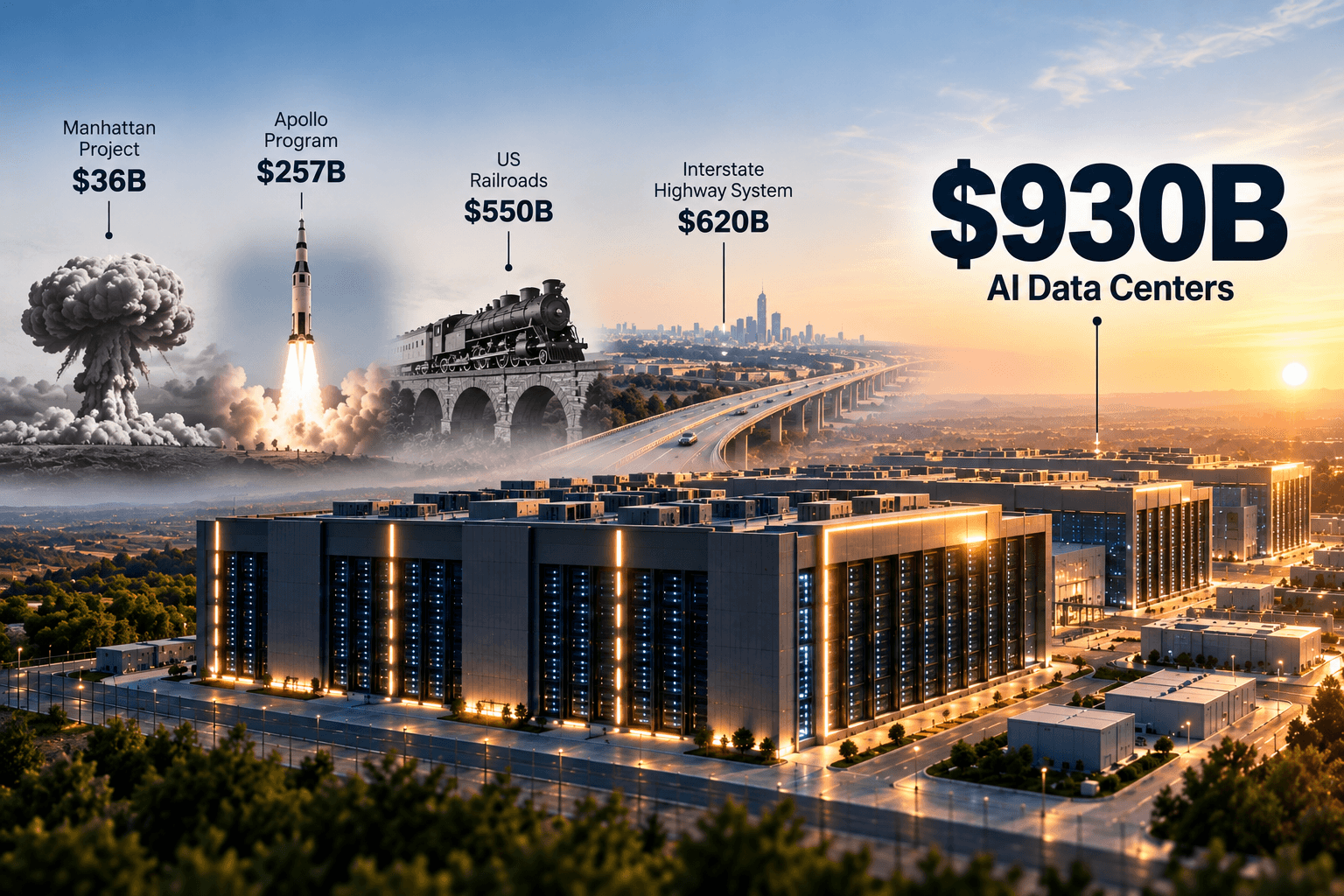
Numbers this big are hard to feel, so here are some comparisons, all adjusted to today's dollars.
| Project | Approx. cost | Time span |
|---|---|---|
| Manhattan Project | $36 billion | About 5 years |
| Apollo program | $257 billion | 14 years |
| US railroads | $550 billion | 71 years |
| Interstate Highway System | $620 billion | 37 years |
| Hyperscaler data centers | $930 billion (estimate) | About 6 years |
The Manhattan Project was a wartime government effort to build the atomic bomb, and it helped bring World War II to an end. Apollo was a Cold War project to put a person on the moon and show US leadership over the Soviets. The railroads and the interstate highways were infrastructure builds that stretched across generations, funded by governments, private ventures, or both.
Data center spending has now passed all of them in raw dollars, and it did so in six years.
Who Owns the Infrastructure, and Why It Matters
Data centers are infrastructure, but the ownership looks very different from the past. Most of it sits with a small number of hyperscalers and large companies, mainly American and Chinese, with a few other countries joining in.
That's a concern of mine. These aren't governments, they're companies run by a board and a CEO, which means a very small number of people are making enormous decisions. Unlike most democratic governments, where leaders can be voted out and replaced with fresh ideas, those leaders can stay in place for the rest of their lives.
Why Are They Spending So Much?
The motive is market capture. These companies are building the engine that makes AI cheap enough to reach more people, with more use cases and more features, so that all of us end up using AI more and more. AI runs on processing power and data, and all of that has to live in data centers.
The second thing that concerns me is the rate of spending. Plot it on a chart and the curve looks like a mathematical singularity, a line climbing steeper and steeper toward infinity. I don't read that as a sign of machines taking over. I read it as growth that can't continue forever.
Why a Correction May Be Coming
I've lived through several boom and bust cycles in my career. The most memorable was the dot-com crash around 2000, when enormous amounts of money poured into companies and then vanished, wiping out people sitting on hundreds of millions of dollars almost overnight. I think a correction this time is a very real possibility. Three things point that way.
Communities are pushing back. Data centers create power, water, and land problems, and nobody wants one in their backyard. Everyone wants the tools and features, but the infrastructure should be somewhere else.
I believe retail AI is heavily subsidized. When you use an AI chat tool, you're likely not paying for all of the compute you receive. Providers keep prices low, and sometimes free, because they want your usage, your data, and your reliance on their tool. But there is never an infinite amount of money, so something has to give.
Not all of the usage is useful. Plenty of real business use cases are already saving companies time and money. But compute spent on throwaway memes doesn't help anyone, and spending that can't be tied to practical value is hard to sustain.
If a correction arrives, the fallout could be dramatic, possibly a recession. I hope I'm wrong and it turns out to be a moderate slowdown instead. Either way, I see a sense of recklessness in the current spending that is likely to have consequences.
What This Means for Owner-Led Businesses
None of this means businesses should avoid AI. It means they should adopt it for the right reasons. For healthcare, construction, and professional services businesses, the useful questions are practical ones:
- Does this use case save time, cut costs, or bring in revenue?
- Can we measure the result?
- Would the business still work if today's low AI pricing changed?
The gap between the hype and the help is wide. The businesses doing well with AI aren't the ones spending the most. They're the ones applying it to specific problems with measurable payoffs, which is exactly what AI Automations are built to do.
It also pays to keep an eye on where AI investment is going and where it starts to show problems. If signs of a slowdown appear, I'd think seriously about putting your time and budget into proven, practical value rather than following the hype. That's my personal view, and I'm not a financial adviser.
Want to cut through the hype and find where AI pays off in your business? Book an AI Level-Up Session and we'll map the use cases with real, measurable returns.
FAQ
How much has been spent on AI data centers? Hyperscaler data center spending is estimated at around $930 billion over roughly six years, from 2020 to 2026. It's an estimate built from corporate reports, so exact figures vary by source.
How does AI spending compare to the Manhattan Project or Apollo? In today's dollars, the Manhattan Project cost about $36 billion and the Apollo program about $257 billion over 14 years. Data center spending has exceeded both combined, in a much shorter time.
Is AI a bubble? Nobody knows for certain. The steep spending curve, community pushback on data centers, and what looks like heavily subsidized AI pricing suggest a correction is a real possibility, similar to the dot-com crash. Hopefully any slowdown is moderate.
Should a small business slow down AI adoption because of this? No, but it should focus on use cases with measurable returns, such as time saved, costs reduced, or revenue gained, rather than following the hype or assuming today's pricing will last forever.