
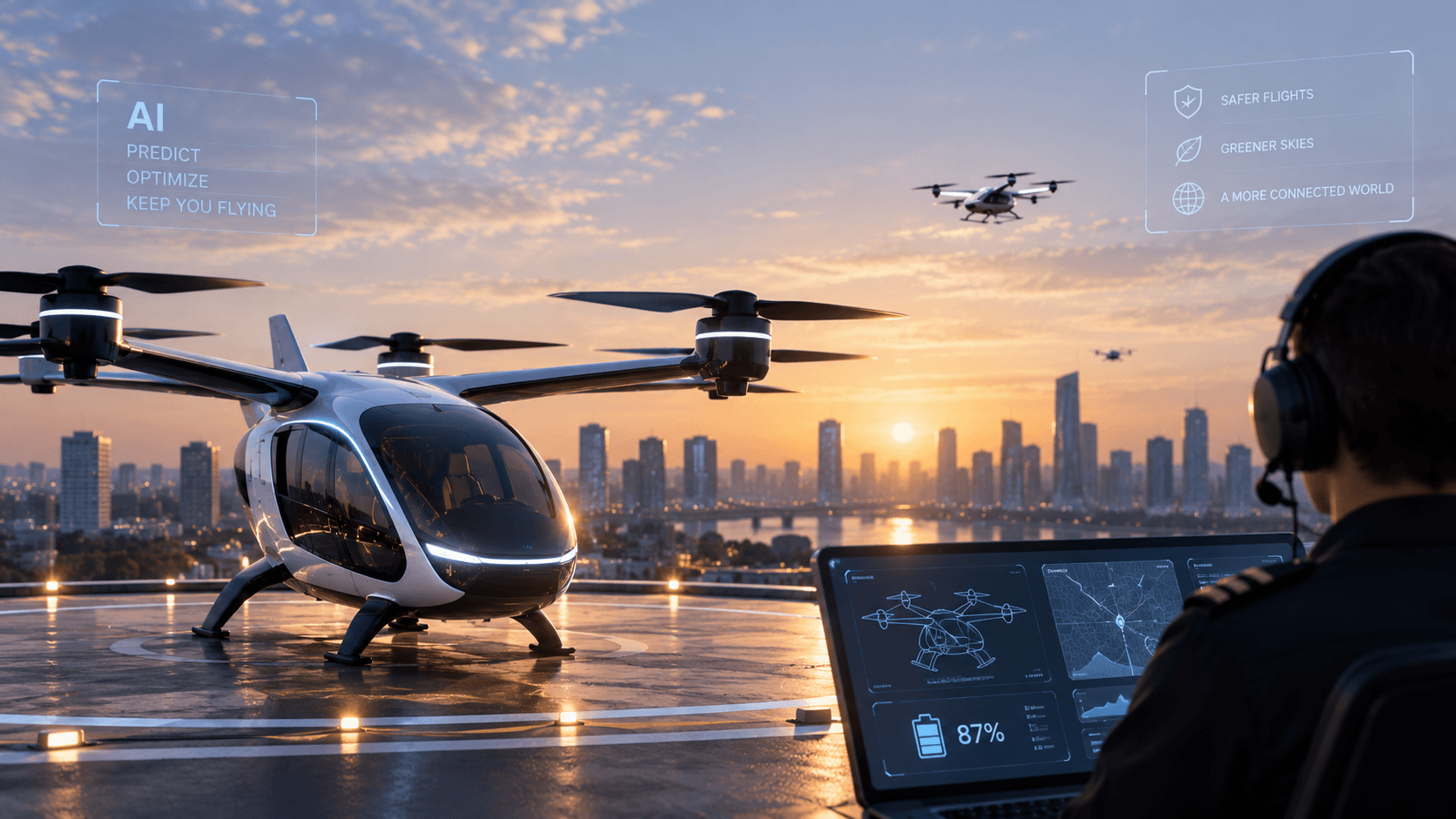
Electric Aviation Is Taking Off, And AI Is in the Cockpit
What is AI's role in electric aviation? It's a question worth asking, and one shaped by a background that spans both worlds. Before spending the last decade working in AI, Pete's earlier career was in aviation itself, as an airline pilot, a flight instructor, and later an engineer working on 747s. More recently, that engineering background led to work with Boeing on fault detection systems. But what's really exciting right now is watching what the broader industry is doing, and the same kind of thinking behind that fault detection work is exactly what powers a well-built AI Automation: systems designed to catch problems before they become expensive ones.
Electric Aviation Is Having Its Moment
Electric aviation is genuinely taking off, in every sense of the phrase. Personal electric vertical takeoff and landing vehicles like Jetson are pushing toward a kind of personal flying vehicle. Air taxi companies like Joby are building electric aircraft for short urban and regional trips. Hart is working with commercial airlines on electrification, and Diamond has already brought electric propulsion into general aviation. Together, these efforts are transforming the industry from several directions at once.
Fuel has historically been one of the largest ongoing costs in aviation, and that cost is dropping dramatically as the industry moves toward electrification. It's a reminder that the biggest AI-driven savings often show up in the cost centers a business has simply learned to live with, the exact opportunities an AI Transformation engagement is built to uncover.
Why Now? The Battery Numbers Finally Work
The timing isn't random. The industry is hitting a long-anticipated milestone in battery performance, roughly 400 watt-hours per kilogram, a benchmark Elon Musk pointed to years ago as the threshold that would make electric flight genuinely viable. That threshold is being reached right now, and it's what's making electric aviation economically practical rather than purely experimental.
Companies across the industry are seeing this shift coming and investing heavily as a result. That same instinct, watching for the moment a technology crosses from experimental to practical, is exactly what an AI Level-Up Session is designed to help a business owner spot inside their own operations.
Where AI Fits Into the Picture
This is also personally exciting on the AI side, because of a product called Hawkeye, originally developed for the cycling industry as a safety camera system, with a clear application emerging in aviation as well. The parallel worth watching: just as electric vehicles paved the way for autonomous cars, electric aviation is likely to pave the way for autonomous aircraft. Once that happens, the cost structure around aviation changes dramatically again.
For the average person, all of this adds up to something tangible: getting around town becomes easier, whether that's through ground-based EVs or, eventually, personal flying vehicles. The idea of a Jetson-style vehicle flying someone to work, once pure science fiction, is now genuinely on the horizon, and AI, electrification, and battery technology are converging to make it happen. It's the same kind of convergence AI Automations brings to a business, several separate tools and processes coming together into one system that just works.
Where This Fits for Business Owners Watching AI Move Fast
Electric aviation is a striking example of a broader pattern: technologies converging at once, batteries, AI, and automation, to unlock outcomes that weren't possible even a few years ago. That same convergence is playing out inside businesses of every size, just on a smaller and more immediate scale. The companies paying attention now, whether they're building aircraft or running a healthcare practice, are the ones positioned to benefit first, and a full AI Transformation engagement is how that attention turns into an actual plan.
If watching this space has you thinking about where AI could be quietly changing your own industry, that's exactly the kind of conversation worth having. Book an AI Level-Up Session to explore where AI is already reshaping your corner of the market, and where it's headed next.
FAQ
How is AI actually used in electric aviation? AI plays a role in areas like fault detection for aircraft systems, safety monitoring, and eventually enabling autonomous flight, similar to how AI has enabled autonomous capability in electric vehicles.
Why is electric aviation becoming viable now? Battery performance has reached roughly 400 watt-hours per kilogram, a threshold long identified as the point where electric flight becomes economically practical rather than experimental.
What companies are leading the shift toward electric aviation? Companies like Joby are building electric air taxis, Diamond has introduced electric propulsion into general aviation, Hart is working with commercial airlines on electrification, and Jetson is developing personal electric flying vehicles.
Will electric aviation lead to autonomous aircraft? It's expected to follow a similar path to electric vehicles, which enabled the rise of autonomous cars. As electric aviation matures, autonomous aircraft are considered a likely next step.