
You're Probably Prompting AI Backwards
There's a common mistake costing people better answers from AI, and it takes about 10 seconds to fix. One shift alone can take an AI's output from generally useful to genuinely sharp.
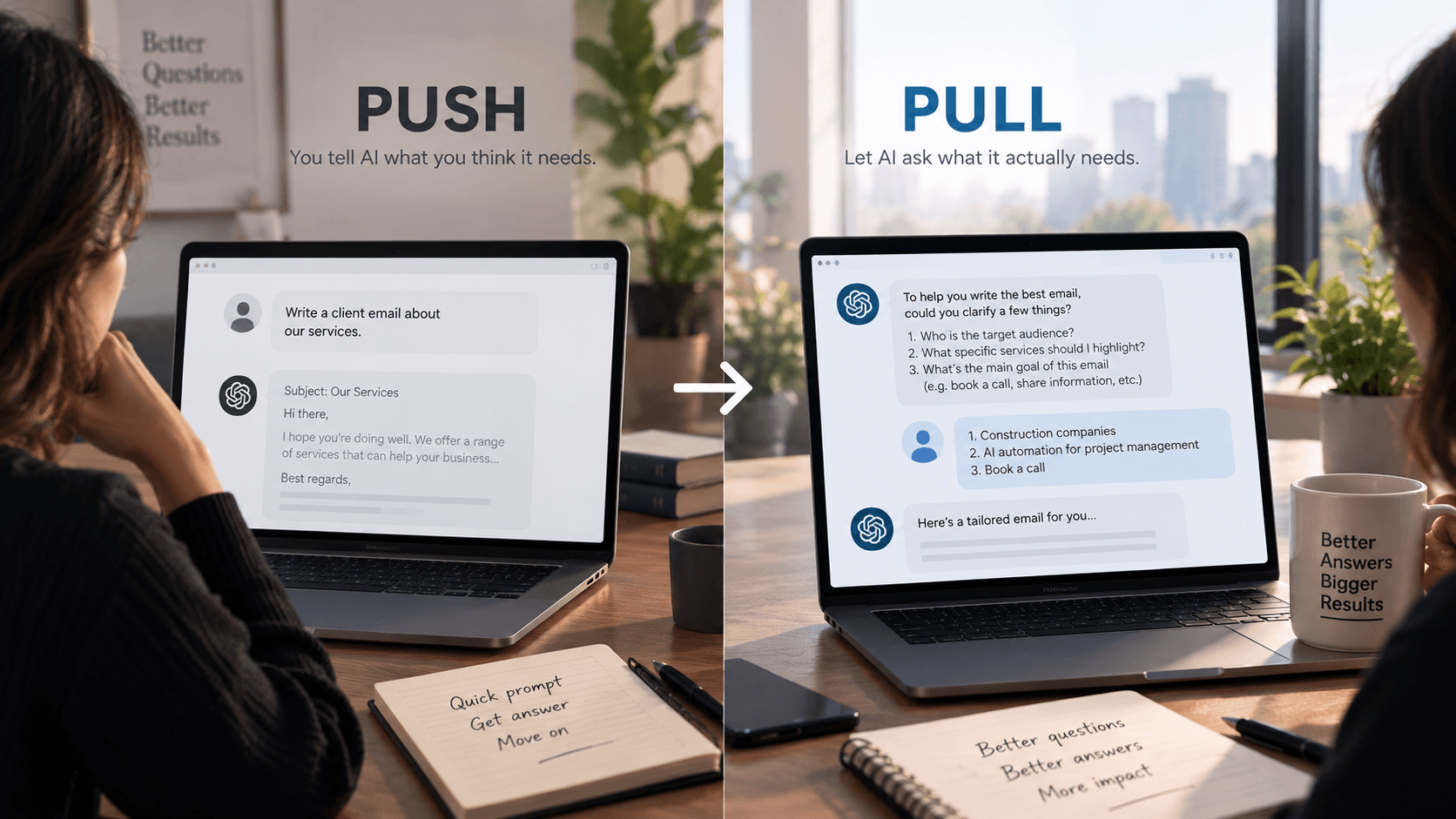
The mistake: roughly 99% of people use AI in what's worth calling "push mode." That means typing something like, "here's my problem, fill in the blank." It sounds efficient. In practice, it limits the answer to your own blind spots, since the AI can only work with the context you happened to think to include.
What Pull Mode Looks Like Instead
Here's what works better: instead of pushing your own assumptions into the prompt, flip it. Say, "here's my situation, here's the outcome I want, ask me the questions you need answered." That's pull mode, letting AI pull the context out of you instead of you guessing which context matters.
The difference in output quality isn't small. Push mode gives you an answer shaped by what you already knew to include. Pull mode gives you an answer shaped by what actually matters, because it's asking rather than assuming.
Why This Matters More Than It Sounds
This isn't just a prompting trick, it's a genuine shift in how useful AI becomes day to day. Most business owners and employees default to push mode without realizing it, because it feels faster to just state the problem and move on. But a faster prompt that produces a mediocre answer isn't actually faster, it usually means more back-and-forth fixing the output afterward, or worse, acting on an answer that missed something important.
For healthcare, construction, and professional services businesses, this shows up constantly. A staff member asks an AI tool to draft a client email, summarize a report, or suggest next steps, and gets back something technically fine but generically shaped, because the AI never had the chance to ask what actually mattered in that specific situation. Something as simple as prompting the AI to ask clarifying questions first can turn a mediocre draft into something genuinely useful.
Where This Fits Into Real AI Adoption
Small prompting habits like this add up, but they only scale across a team when someone's actually teaching them. This is exactly what an AI Level-Up Session is built for, quick, practical shifts like push versus pull that immediately improve how a team gets value out of AI, without needing a long training program.
And for businesses looking to build these habits directly into their workflows, so staff don't have to remember to prompt this way every time, AI Automations can bake pull-mode questioning directly into the tools your team already uses.
Want to find out what other small habits are quietly limiting your team's AI output? Book an AI Level-Up Session and we'll show you what's easy to fix.
FAQ
What's the difference between "push mode" and "pull mode" when prompting AI? Push mode means stating your problem and letting the AI fill in the blank based only on what you included. Pull mode means asking the AI to ask you clarifying questions first, so the response is shaped by what actually matters rather than what you happened to think to mention.
Why does pull mode produce better AI output? It removes the limitation of your own blind spots. Instead of the AI guessing at missing context, it asks for it directly, resulting in an answer shaped by the actual situation rather than assumptions.
Is pull mode harder or slower to use? No, it typically takes seconds longer to set up, but usually saves time overall by reducing the back-and-forth needed to fix a generic first answer.
How can a business make sure their whole team prompts this way? Training on simple prompting habits, like push versus pull, can be taught quickly in a focused session, and can also be built directly into automated workflows so the right prompting pattern happens by default.