
The Real Cost of AI: Why Business AI Is Cheaper Than You Think
For many business owners, one of the biggest concerns about adopting artificial intelligence is cost.
"We'd love to use AI, but it sounds expensive."
It's a reasonable concern, but it's also one of the biggest misconceptions about AI today.
The reality is that while AI can be incredibly expensive behind the scenes, most businesses are paying only a tiny fraction of its true cost. Understanding why can help business owners make better decisions about AI adoption and appreciate the extraordinary value these tools now provide.
A Real-World Experiment
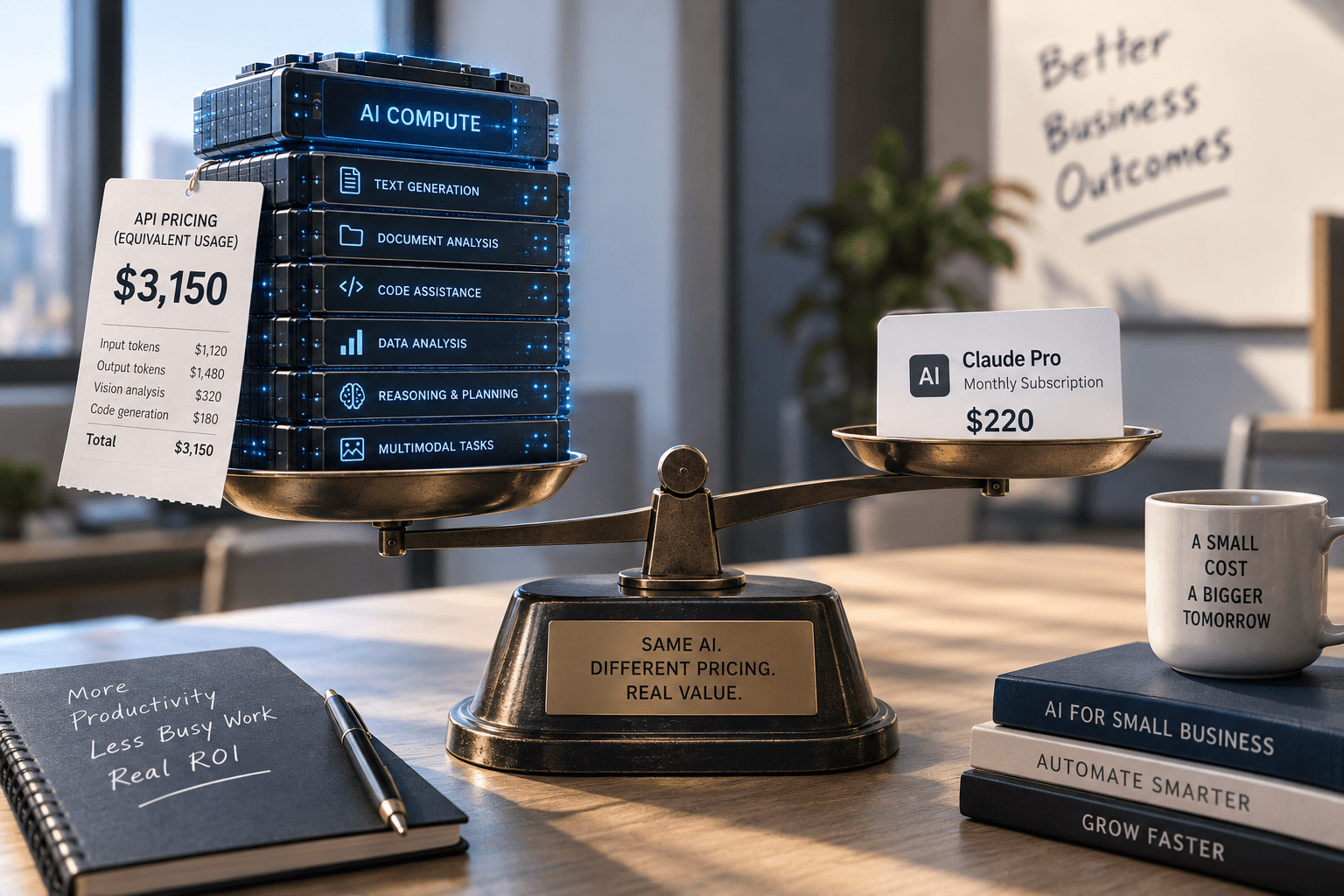
One of our software developers uses Claude Pro as his primary AI assistant. His subscription costs approximately $220 per month.
Out of curiosity, we wanted to know what those conversations would have cost if every interaction had been billed at the published API pricing instead of being included in a monthly subscription.
Using a token analysis tool, we calculated the number of tokens consumed and applied the pricing for the AI models being used.
The result was surprising.
The actual usage came to approximately $3,150 worth of AI compute.
Yet the developer paid only $220.
That's more than 14 times the value of what was consumed.
Why Is There Such a Big Difference?
AI companies generally offer two ways to access their models.
Consumer subscriptions. Products such as ChatGPT Plus, Claude Pro, and similar services charge a fixed monthly fee. These plans are designed for individual users and include generous usage limits, since not everyone uses the service heavily every day. For many professionals, this represents exceptional value.
API usage. Developers building AI-powered software typically access models through APIs. Instead of paying a monthly subscription, they pay for every token processed. Every prompt, every document, every generated response, and every automated workflow consumes tokens, creating a direct operational cost. For businesses building AI products or large-scale automations, these API costs become an important part of the overall business model.
What This Means for Small and Medium Businesses
This is actually good news.
If your business is using AI to help employees write emails, summarize meetings, analyze documents, generate reports, or improve productivity, you're often receiving thousands of dollars worth of computing power for a relatively small monthly subscription.
That makes AI one of the highest-return technology investments many businesses can make.
For organizations with between 5 and 50 employees, the savings created by reducing administrative work frequently outweigh the subscription costs many times over.
But AI Isn't Always Cheap
There are situations where AI costs increase significantly. Businesses may see higher expenses when they:
- Build custom AI applications
- Process large volumes of documents
- Run AI continuously through automated workflows
- Use premium reasoning models
- Serve hundreds or thousands of customers through AI-powered products
In these cases, understanding API pricing and usage optimization becomes critical. Fortunately, there are many ways to design AI systems that deliver excellent business outcomes while keeping operating costs under control, this is exactly where AI Automations makes a real difference, building workflows that are efficient by design rather than accumulating unnecessary API spend.
Focus on Return on Investment, Not Subscription Cost
One of the biggest mistakes we see is businesses asking, "How much does AI cost?"
A much better question is, "How much value does AI create?"
If AI saves an employee just one hour every day, improves customer response times, reduces errors, or allows your team to serve more clients without hiring additional staff, the return can be substantial. The monthly subscription is often the smallest part of the equation.
The Bottom Line
Yes, AI can be expensive behind the scenes. The infrastructure required to run today's advanced AI models costs providers billions of dollars.
But thanks to subscription models and fierce competition among AI companies, businesses can currently access an extraordinary amount of computing power for remarkably little money. For many organizations, there has never been a better time to begin adopting AI.
The key isn't simply choosing the latest AI tool, it's identifying the business processes where AI can deliver measurable improvements in productivity, profitability, and customer service.
At Skillion AI Labs, we help healthcare, construction, and professional services businesses identify those opportunities, implement practical AI solutions, and ensure successful adoption across the organization.
AI isn't the objective. Better business outcomes are.
Not sure if AI actually makes financial sense for your business yet? Book an AI Level-Up Session and we'll walk through the real numbers, what it would cost, what it could save, and where the highest-value opportunities are for your team.
FAQ
Is AI actually expensive for a small business? Usually not. Most businesses access AI through consumer subscriptions like ChatGPT Plus or Claude Pro, which often provide far more value in AI compute than the subscription price reflects.
Why is API pricing so much higher than a subscription? API pricing charges for every token processed individually, which is designed for businesses building custom AI products or large-scale automations. Subscription plans bundle generous usage into one fixed monthly price, which is far more cost-effective for typical day-to-day use.
When does AI actually become expensive? Costs rise when a business builds custom AI applications, processes large volumes of documents, runs AI continuously through automated workflows, or serves AI to large numbers of customers. These situations benefit from careful cost planning and optimization.
What's the right way to evaluate whether AI is worth the cost? Focus on return on investment rather than subscription price. Consider time saved, error reduction, faster response times, and capacity gained, then compare that value against the relatively small monthly cost of most AI tools.