
What the Alcatraz Escape Teaches Us About Real AI Power
Has AI solved the famous escape from Alcatraz? If you don't know the story, the short version, and the excellent film version, is the 1979 Clint Eastwood movie Escape from Alcatraz.
The very brief overview: three men, Frank Morris and the Anglin brothers, tunneled out of their cells, built a raft and other equipment from salvaged materials including raincoats, and escaped the building and the island across the San Francisco Bay. Alcatraz sits in the middle of the bay, surrounded by strong currents, cold water, and genuinely treacherous conditions.
Subsequent investigations were never conclusive. Authorities eventually declared that the men perished during the crossing. Some bones were found, but their bodies were never recovered and the men were never seen or heard from again.
Where AI Enters the Story
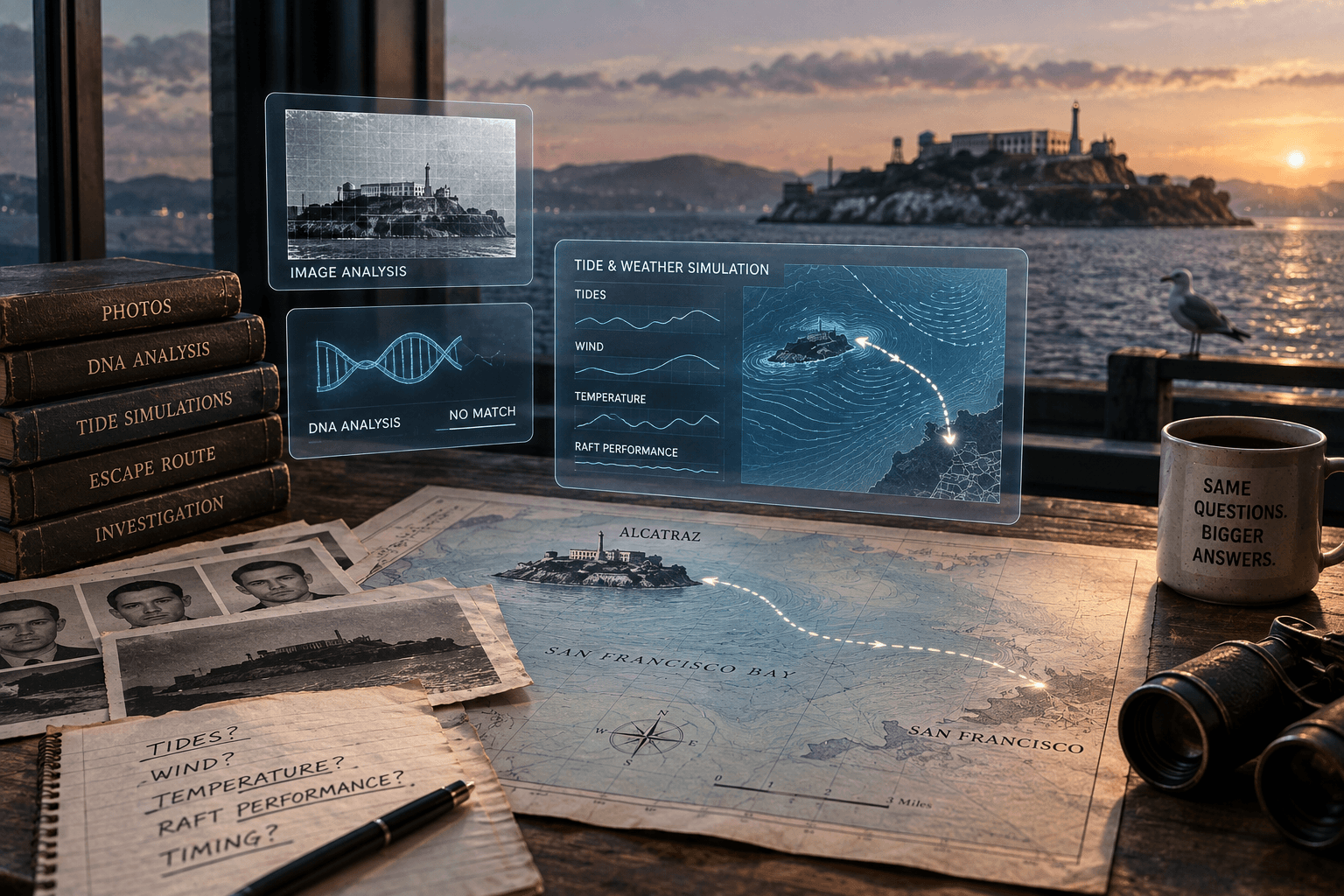
Here's where it gets interesting. The bones that were found were proven, years later, through DNA analysis, to not belong to any of the three men. More recently, a photo that surfaced in 1975 was run through AI analysis. The result was inconclusive, it couldn't prove the photo showed aged versions of the escapees, and it turned out to be two unrelated brothers. But it also didn't rule the possibility out.
The third and most recent piece of analysis, done just this year, is a detailed AI simulation of the tides, winds, temperatures, and other conditions, including how a raft like theirs would have performed specifically under the weather conditions on that night.
That analysis, run under many different scenarios, showed that if the men had left at exactly the right time, within about an hour's margin, they could have made it across. That theory gets more weight from the fact that Frank Morris was known for his high intelligence and detailed planning. It's plausible he chose that specific night and understood the tides well enough to actually make it to freedom.
None of this proves AI has solved the case. What it has done is move the investigation meaningfully forward.
Why This Actually Matters Beyond the Story
What's notable here isn't really the true crime angle, it's what kind of problem AI was actually useful for. It wasn't guessing or storytelling. It was running a complex simulation across dozens of variables, tides, wind, temperature, boat performance, and testing them against a wide range of scenarios to find the small window where the numbers actually worked.
That's the same kind of capability that applies directly to running a business. Whether it's forecasting the best time to schedule a resource-heavy project around weather and supply timelines in construction, modeling patient flow and staffing needs in a healthcare practice, or simulating different pricing or capacity scenarios in a professional services firm, the underlying skill is the same: taking a mess of real-world variables and finding the answer buried inside them.
Where This Fits Into a Real AI Strategy
This is exactly the kind of analytical heavy lifting AI Automations is built to apply to your actual operations, not a historical mystery, but the scheduling, forecasting, or planning problem sitting in your business right now. And for businesses that want this kind of analytical capability built into how they operate day to day, a full AI Transformation engagement identifies where that kind of modeling can create real, measurable value.
Curious what kind of complex problem AI could untangle in your business? Book an AI Level-Up Session and we'll help you find out.
FAQ
Did AI actually solve the Alcatraz escape case? No. AI analysis strengthened one theory, that the escapees could have survived the crossing under the right conditions, but it hasn't conclusively proven what happened to Frank Morris and the Anglin brothers.
What kind of AI analysis was used in the case? Two main types were involved: AI-assisted photo analysis to examine a photograph that surfaced years later, and a detailed AI simulation of tides, wind, and water conditions on the night of the escape.
What does this case reveal about AI's real strengths? It shows AI is especially powerful at modeling complex scenarios with many variables, weather, timing, physical performance, and finding patterns or windows that would be very difficult to calculate manually.
How does this apply to a small business? The same modeling capability used to simulate tides and timing can be applied to business problems like scheduling, staffing forecasts, or planning around variable conditions, turning complex data into a clear, usable answer.