
Why a Great AI Demo Isn't a Finished Product
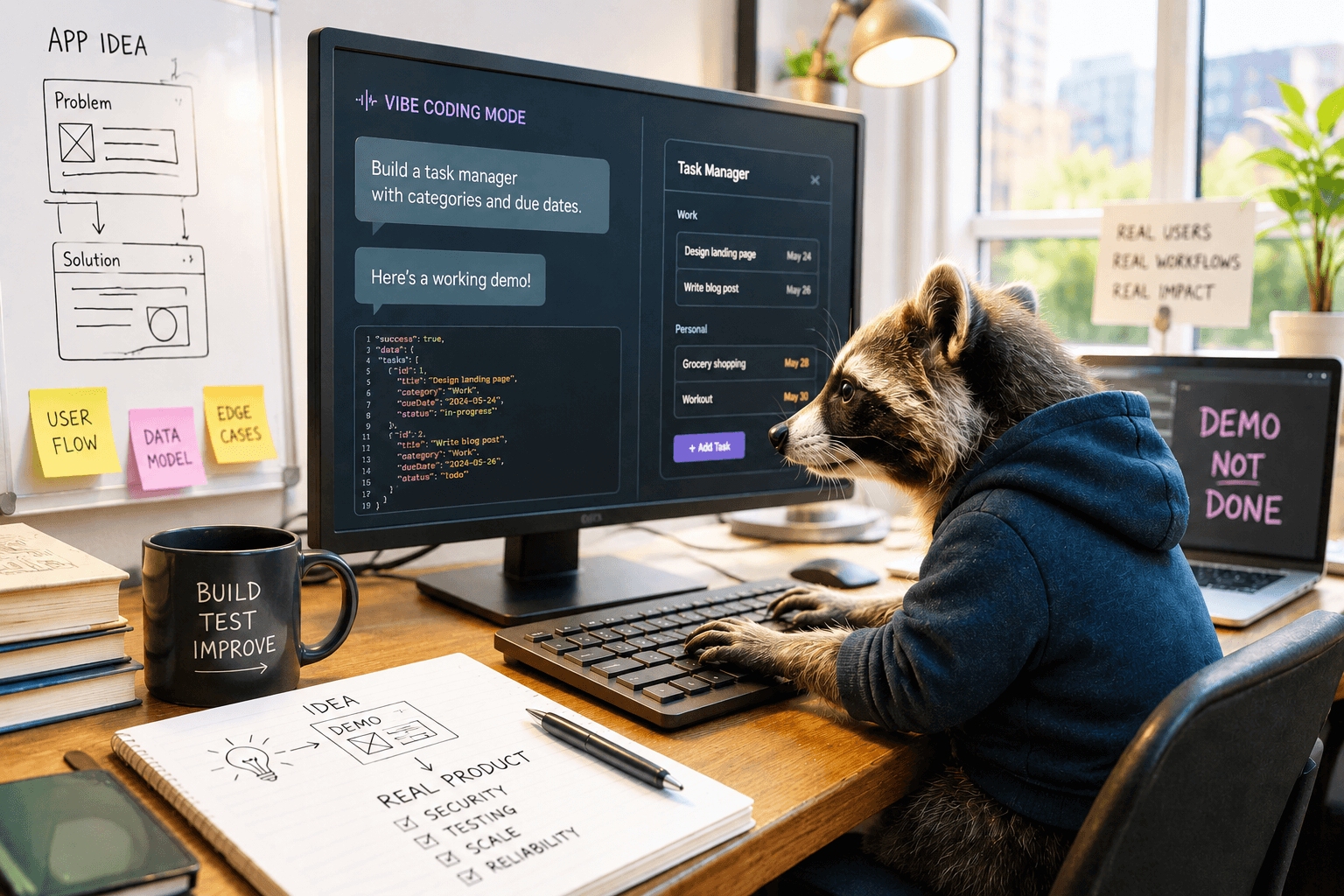
Vibe coding has become a bit of a trend, and some people say it isn't such a good idea. What it actually is: using an LLM like GPT or Claude to develop an app, which in practice means developing a demo or an early prototype. That's genuinely useful. It can quickly show you whether an idea is going to work, and you can keep refining it from there.
What it isn't is the complete software development cycle. It's missing two pieces.
The Three Parts of Every Real Software Project
Picture a full project broken into thirds.
The front third is defining the requirements. That's where you talk to your customers, understand their actual workflows, and figure out what problem you're solving.
The back third is turning that prototype or demo into something production ready. That's also a heavy lift, testing, security, integration with existing systems, and everything else a real business tool needs.
Those two pieces haven't changed with vibe coding. What has changed is the middle third: the ability to produce a working demo quickly. That's genuinely reduced the overall software development timeline, but it hasn't eliminated the requirements work or the production buildout.
The Risk: Mistaking a Prototype for a Finished Product
This is where unrealistic expectations creep in. Watching an AI tool spin up a working demo in an afternoon makes it easy to assume the hard part is done. It isn't. The requirements work still has to happen, and turning a demo into something reliable enough to run a business on is still a serious undertaking.
For owner-led businesses in healthcare, construction, and professional services, this distinction matters more than it might seem. A vibe-coded demo of a scheduling tool or an intake form might look finished in a screen recording, but without the requirements work behind it, it likely doesn't handle your actual edge cases, your compliance needs, or how your team really works day to day. And without the production buildout, it likely isn't secure or stable enough to hand to your staff or your clients.
Where This Fits Into a Real AI Strategy
None of this means vibe coding isn't valuable, it's a genuinely useful way to test an idea fast before committing real budget to it. The mistake is treating that early prototype as the finish line.
This is exactly the gap AI Automations is built to close: taking a proven concept and turning it into something production-ready that actually runs inside your business, reliably and securely. And when the need is bigger than one tool, a full AI Transformation engagement handles the requirements work up front, so what gets built actually reflects how your team operates, not just what a quick demo could show.
Have a prototype that needs to become the real thing? Book an AI Level-Up Session and we'll map out what it actually takes to get there.
FAQ
What is vibe coding? Vibe coding is using an LLM like GPT or Claude to build an app by describing what you want in natural language, typically producing a working demo or early prototype quickly.
Can vibe coding replace a real software development process? No. Vibe coding speeds up the middle part of development, producing a working demo, but it doesn't replace the requirements work at the start or the production buildout at the end.
Why does a vibe-coded demo often fail in real business use? A demo is usually built without a full understanding of actual workflows, edge cases, or compliance needs, and without the testing and security work needed to run reliably in production.
Is vibe coding still worth using for a small business? Yes, as a fast way to test whether an idea works before committing real budget. The key is treating it as a starting point, not a finished product.