
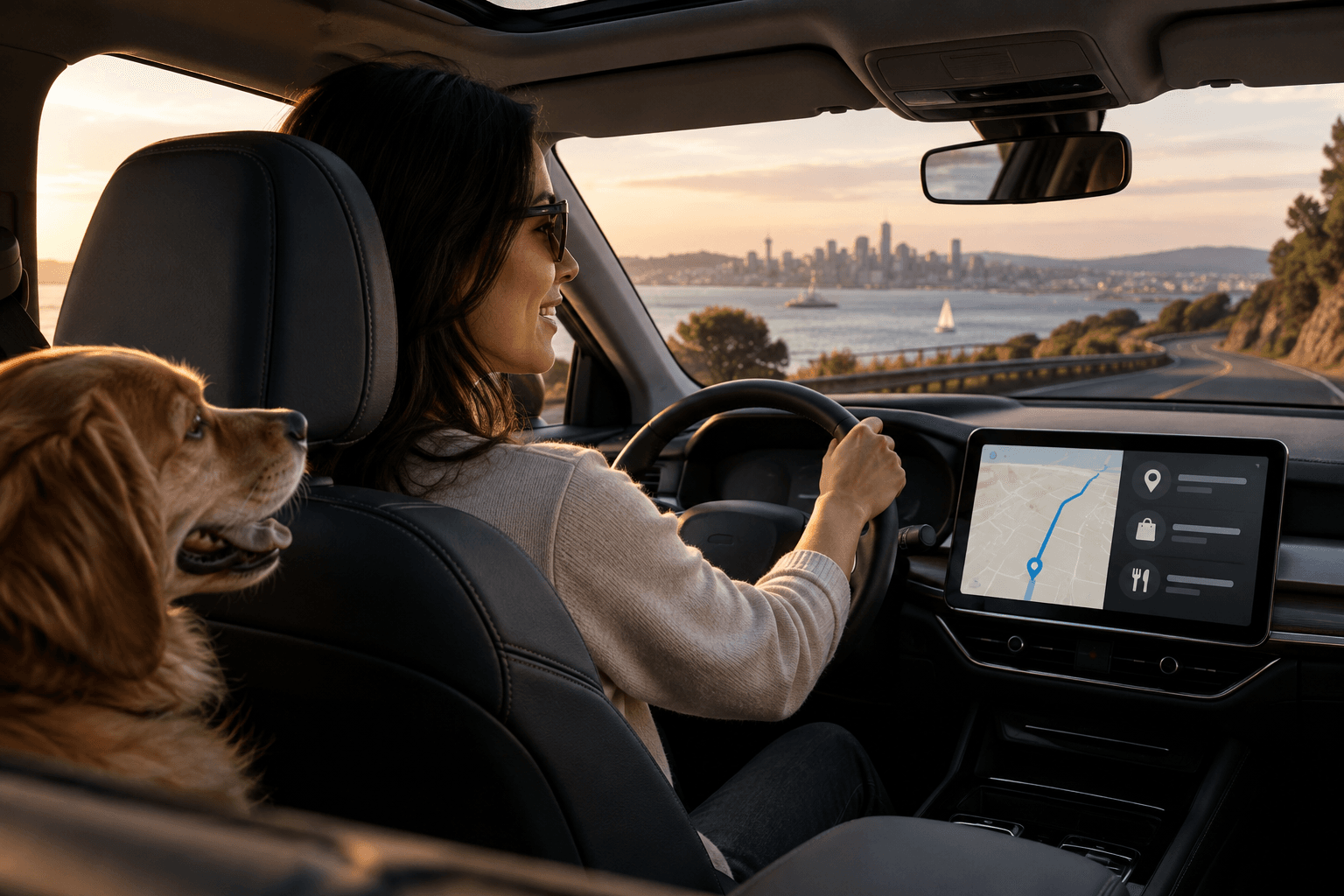
AI Chat Is Coming to Cars — And It Could Change How We Drive
For years, the technology inside cars has become progressively more sophisticated. Touchscreens have replaced buttons, navigation systems have become connected to live traffic data, and voice commands can control everything from music to cabin temperature.
But despite all that technology, we still largely operate the car's digital systems ourselves.
Want to go somewhere? Open navigation, enter an address and select a route. Want to find a coffee shop along the way? Search for one, choose it and modify the journey.
Generative AI and conversational AI could fundamentally change that relationship.
Instead of operating the car's technology, we'll simply tell the car what we're trying to accomplish.
From Voice Commands to AI Conversations
Voice control in cars isn't new. Drivers can already ask their vehicles or connected smartphones to make calls, play music, adjust settings and navigate to destinations.
AI chat introduces something much more powerful: context.
Rather than issuing a series of individual commands, drivers will be able to have an ongoing conversation with an AI assistant that understands the journey, the people involved and what the driver is trying to achieve.
Imagine getting into your car and saying:
"Take me to Joe Smith's house."
The AI identifies the Joe Smith in your contacts, confirms the address and begins navigation.
Nothing revolutionary yet.
But halfway there, you remember it's Joe's birthday.
You say:
"I need to get Joe a birthday present. He likes Belgian chocolates. Is there somewhere good on the way?"
Now the AI has a problem to solve rather than simply a command to execute.
It could search for suitable stores, compare their locations with your existing route, consider opening hours, estimate the additional travel time and present you with the best options.
Perhaps one store is highly rated but adds 20 minutes to the journey, while another good option adds only five.
You choose the closer store.
The car automatically updates the route.
That's a fundamentally different experience from navigating through menus and applications.
Your Car Becomes a Personal Assistant
The bigger opportunity isn't simply better voice control.
It's the combination of conversational AI, real-time information and the ability to take actions on the driver's behalf.
The AI assistant could potentially understand your calendar, contacts, route, preferences and destination while interacting with other services.
That could make requests such as these increasingly natural:
- "Find somewhere good for lunch near my next meeting."
- "I'm running late. What's the fastest route?"
- "Find a fuel station before we get on the highway."
- "Where can I stop for coffee without adding more than five minutes?"
- "Remind me to call Sarah when I've parked."
- "Find parking close to my appointment."
The important difference is that the driver doesn't need to think about which application to open or which sequence of buttons to press.
They simply explain the desired outcome.
The AI works out how to achieve it.
From Software Interfaces to Intent
This shift has implications far beyond the automotive industry.
For decades, humans have adapted themselves to computers.
We learned where buttons were located, how menus worked, which applications performed particular tasks and what information needed to be entered into each field.
Generative AI is beginning to reverse that relationship.
Increasingly, we can describe an intent and allow software to determine the actions required to achieve it.
That's why the development of conversational AI inside cars is worth watching even if you're not in the automotive industry.
It demonstrates a much broader change in how people will interact with technology.
What This Means for Small and Medium Businesses
The same principle applies inside established businesses.
Many companies with 5 to 50 employees have accumulated a collection of accounting systems, CRMs, spreadsheets, email accounts, project-management platforms and industry-specific applications.
Employees spend significant amounts of time moving between those systems.
The opportunity for AI isn't necessarily to replace those applications.
It's to create an intelligent layer across them.
Imagine a construction business owner asking:
"Which projects are most likely to run over budget this month, and what should I be looking at?"
Or the owner of a healthcare practice asking:
"Which outstanding insurance payments need our attention today?"
Or the managing partner of a professional services company asking:
"Which clients haven't been contacted in the last 30 days and have open opportunities?"
The AI could retrieve information from multiple authorized systems, analyze it and present an actionable answer.
Eventually, with the right permissions and safeguards, it could also take approved actions.
That's the business equivalent of asking your car to find Belgian chocolates on the way to a friend's house.
The Real AI Opportunity Is Better Business Outcomes
This is an important distinction for business owners considering AI adoption.
AI itself isn't the objective.
The objective might be reducing administrative overhead, improving margins, responding to customers faster, finding revenue opportunities or giving employees more time to perform higher-value work.
The technology matters only when it helps achieve those outcomes.
That's why successful AI adoption should start with the business problem rather than the latest AI tool.
At Skillion AI Labs, we work with established small and medium businesses—particularly in healthcare, construction and professional services—to identify where AI can produce measurable operational and financial improvements.
That means examining existing workflows, systems and data before deciding where automation, AI agents or conversational interfaces actually make sense.
The Future May Feel Less Like Using Technology
The most interesting thing about AI chat in cars may ultimately be how invisible the technology becomes.
You won't necessarily think:
"I'm using generative AI."
You'll simply talk.
The vehicle will understand what you're trying to accomplish, find the information it needs and help coordinate the journey.
In effect, getting into your car could begin to feel less like operating a collection of software and more like travelling with a personal assistant and chauffeur combined.
And the same transformation is likely to happen inside businesses.
The companies that benefit most won't necessarily be those with the most AI tools.
They'll be the ones that redesign how people interact with technology so that employees spend less time operating systems—and more time achieving outcomes.
AI isn't the destination. It's increasingly becoming the way we get there.