
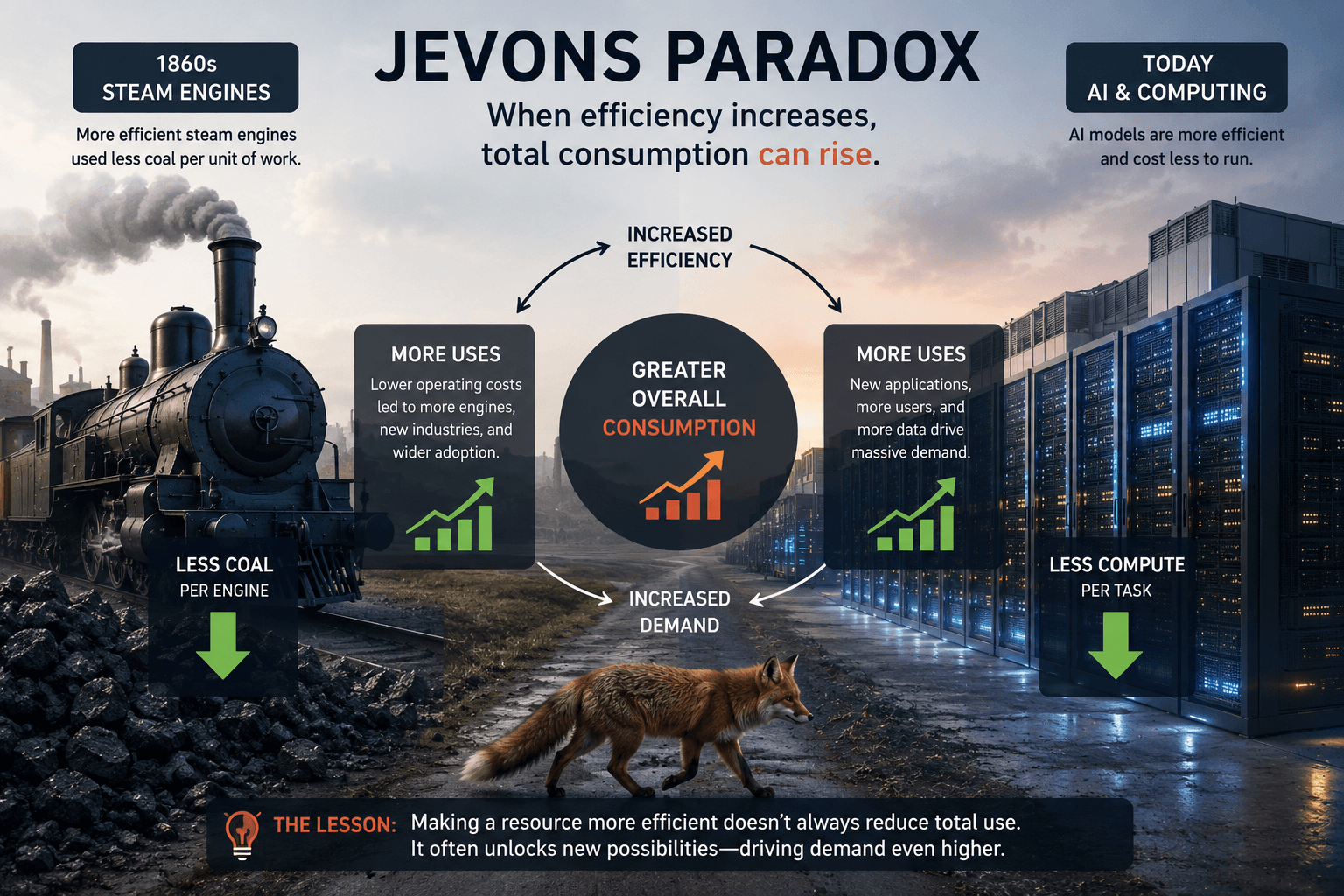
Jevons Paradox: Why More Efficient AI Is Driving Even Greater Demand
Reading time: 4–5 minutes
Artificial intelligence is becoming dramatically cheaper, faster, and more capable every month. Common sense suggests that as AI becomes more efficient, businesses should require fewer computing resources.
The reality is exactly the opposite.
This phenomenon was identified more than 160 years ago and is known as Jevons Paradox. Understanding it helps explain why AI adoption is accelerating so rapidly—and why businesses that delay implementing AI may find themselves falling behind.
What Is Jevons Paradox?
In 1865, economist William Stanley Jevons made an unexpected observation during the Industrial Revolution.
Steam engines were becoming significantly more efficient. Each engine required less coal to perform the same amount of work.
You would naturally assume that coal consumption would fall.
Instead, the opposite happened.
Because steam engines became cheaper to operate, businesses discovered countless new applications for them. More factories adopted steam power, new industries emerged, and entirely new business models became economically viable.
The result?
Total coal consumption increased dramatically.
This became known as Jevons Paradox—the idea that increasing the efficiency of a resource often leads to greater overall consumption, because it becomes economical to use it in many more situations.
AI Is Following Exactly the Same Pattern
Artificial intelligence is experiencing precisely the same economic forces today.
Every new generation of AI models is becoming:
- Faster
- More accurate
- Less expensive
- Easier to deploy
- More capable of solving complex business problems
At first glance, that should reduce demand for computing power.
Instead, it has created an explosion of entirely new AI applications.
Businesses are now using AI to:
- Automate customer service
- Generate marketing content
- Analyse financial data
- Assist software development
- Improve healthcare administration
- Optimise construction project management
- Process legal and compliance documentation
- Manage internal knowledge
- Build AI agents that work alongside employees
As AI becomes cheaper, organisations simply find more valuable ways to use it.
Why This Matters for Small and Medium Businesses
Many business owners believe they should wait.
After all, AI will almost certainly become cheaper next year.
They're probably right.
But that's the wrong question.
The real question is:
What competitive advantage are your competitors building while they're using AI today?
As AI becomes more affordable, adoption accelerates.
Businesses that begin integrating AI into their operations now are building:
- Better internal processes
- Higher-quality business data
- More efficient workflows
- Greater employee confidence with AI
- Faster organisational learning
These advantages compound over time.
The technology becomes less expensive—but the competitive gap becomes larger.
The Hidden Cost of More Efficient AI
One of the most fascinating consequences of Jevons Paradox is that increased efficiency actually drives demand for the infrastructure that supports AI.
Around the world we're seeing enormous investment in:
- GPU manufacturing
- Semiconductor production
- Data centre construction
- Cloud infrastructure
- Electricity generation
- Cooling technologies
- High-speed networking
Every improvement in AI capability unlocks hundreds of new commercial opportunities.
Each new application requires additional computing resources.
Rather than reducing demand, AI efficiency is driving one of the largest infrastructure investment cycles in modern history.
The Business Lesson Behind Jevons Paradox
Jevons Paradox teaches us an important lesson.
Technology rarely reduces demand.
Instead, it creates entirely new opportunities.
Businesses that view AI purely as a cost-cutting tool are missing its biggest advantage.
The organisations seeing the greatest return from AI are using it to:
- Deliver better customer experiences
- Increase operational capacity
- Improve business decision-making
- Launch new products and services
- Scale without proportionally increasing headcount
AI isn't simply making existing work cheaper.
It's making entirely new forms of work commercially possible.
Practical AI Adoption Beats Waiting
For owner-led businesses, success doesn't come from experimenting with every new AI tool.
It comes from identifying the business processes where AI delivers measurable commercial outcomes.
Typical high-impact opportunities include:
- Reducing administrative overhead
- Automating repetitive workflows
- Improving reporting and business intelligence
- Supporting customer service teams
- Accelerating proposal and document creation
- Streamlining project management
Businesses that start with practical, high-value AI projects build momentum while competitors are still deciding whether to begin.
Final Thoughts
Jevons Paradox explains one of the most important trends shaping today's AI economy.
As artificial intelligence becomes more efficient, businesses don't use less AI.
They use significantly more of it.
That increased adoption fuels greater investment in computing infrastructure, creates entirely new business opportunities, and continually raises the competitive expectations across every industry.
For small and medium-sized businesses, the message is clear.
Waiting for AI to become cheaper isn't a strategy. By the time it does, your competitors may already have transformed the way they operate.
The businesses that thrive over the next decade won't necessarily be those with the biggest budgets. They'll be the organisations that learn how to apply AI in practical, measurable ways that increase profitability, reduce operational costs, and create sustainable competitive advantage.
How Skillion AI Labs Helps
At Skillion AI Labs, we help owner-led businesses with 5–50 employees identify where artificial intelligence can deliver the greatest return on investment.
Rather than simply implementing AI tools, we work alongside business leaders to identify high-value opportunities, improve workflows, automate repetitive tasks, enhance data quality, and ensure successful adoption across the organisation.
Whether you're in healthcare, construction, or professional services, we help you build a practical AI roadmap that delivers measurable business outcomes and positions your business to compete effectively in an AI-driven economy.