
The AI Pricing Shift Most Businesses Are Missing
Every AI lab claims to have the best, latest model. Anthropic just released Fable 5.1, and it's set some new standards, but not necessarily in the way most headlines are framing it.
Fable 5.1 is essentially what Mythos has been, wrapped with additional safeguards for general use. Mythos itself first came out as a highly capable model restricted to a small group of vetted cybersecurity and life-sciences organizations through Anthropic's Project Glasswing program, it was considered too capable for general use on its own. With Fable 5.1, Anthropic has packaged that same underlying capability with safeguards in place, making it accessible to everyone else.
Benchmarks Aren't the Real Story Here
Fable 5.1 does lead on several published benchmarks, more than doubling its predecessor's score on a key agentic research benchmark, for example. But the benchmark race isn't actually the most useful part of this release for a business owner.
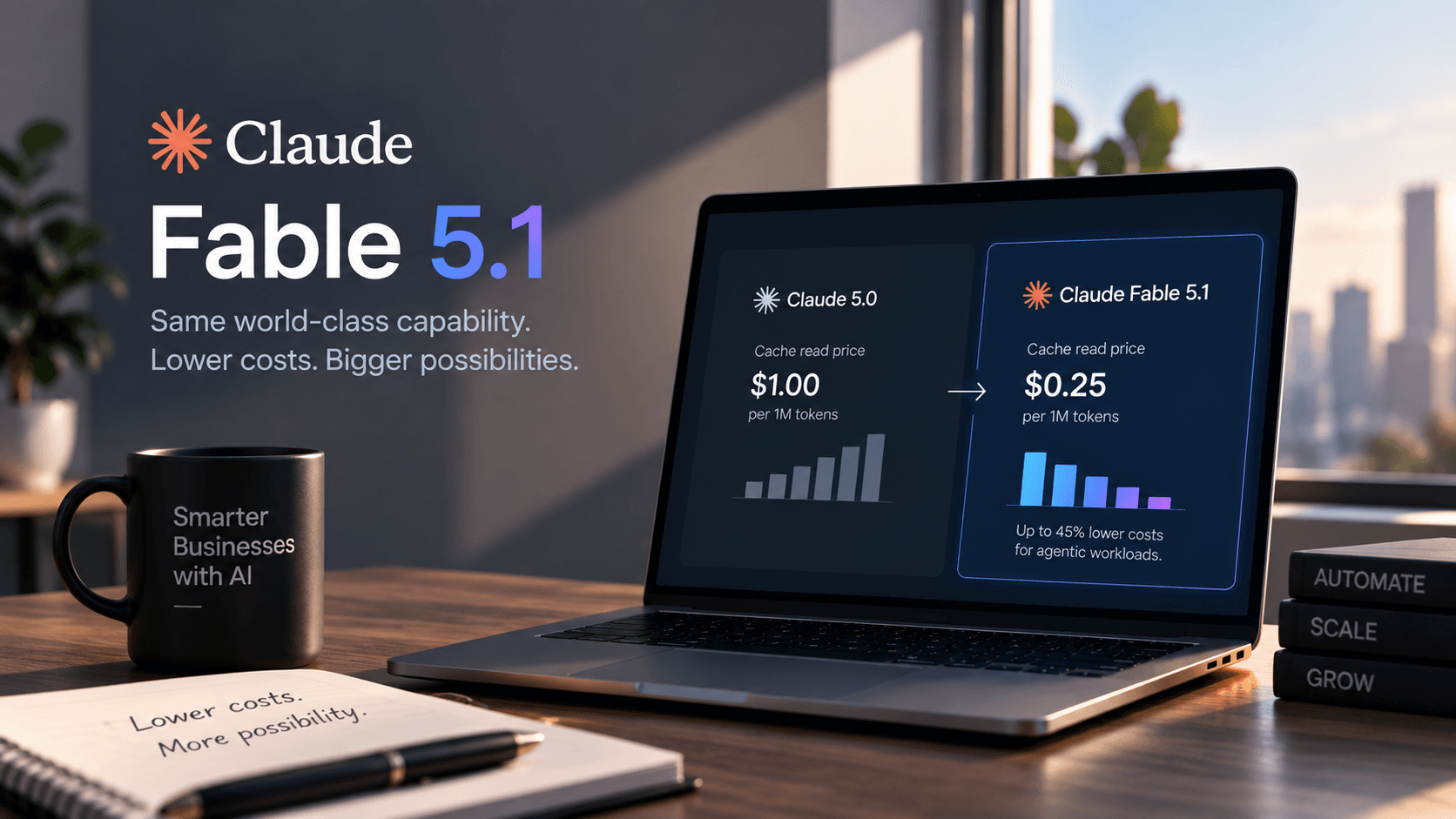
The part worth paying attention to is cost. Anthropic cut the price of cache reads, the cost of reusing information the model has already processed, by 75%. For everyday use, that translates to roughly 25% lower effective cost. For heavily agentic workloads, tasks where AI is running repeated, long processes on its own, that savings climbs to as much as 45%.
Why This Matters More Than a Benchmark Score
Most of the public conversation around new AI models focuses on capability: what can it do that it couldn't do before. What often gets skipped is the cost side of the equation, and cost is usually the part that actually determines whether a business can justify using AI more heavily.
A model that's marginally smarter but meaningfully cheaper to run is often the more valuable release for a small or mid-sized business, since it changes what becomes affordable to automate in the first place. Tasks that were previously too expensive to run continuously, ongoing monitoring, ongoing document review, multi-step agent workflows, become more realistic once the cost per task drops by close to half.
Why This Matters for Owner-Led Businesses
For healthcare, construction, and professional services businesses, this kind of pricing shift matters more than the benchmark headlines suggest. It's often the difference between a promising AI pilot that gets shelved because it's too expensive to run continuously, and one that actually becomes part of daily operations.
This is exactly the kind of shift AI Automations is built to take advantage of, workflows designed around how the underlying AI actually gets priced, so cost doesn't quietly become the reason a good idea gets abandoned.
Curious whether a recent AI pricing shift changes what's now affordable for your business? Book an AI Level-Up Session and we'll walk through what's realistic at today's pricing.
FAQ
What is Claude Fable 5.1? Fable 5.1 is Anthropic's newest publicly available AI model, built on the same underlying capability as its more restricted Mythos model, but with additional safeguards that make it suitable for general use.
Why does the cache-read price cut matter more than benchmark scores? Cost determines what a business can actually afford to run continuously. A 75% cut to cache-read pricing lowers the effective cost of AI workflows by 25 to 45%, which can make previously unaffordable automations financially viable.
Who has access to Mythos, the more powerful version? Mythos access is restricted to a small group of vetted organizations, primarily in cybersecurity and life sciences, through Anthropic's Project Glasswing program, rather than being generally available.
What does this mean practically for a small business using AI? Lower running costs mean tasks that were previously too expensive to automate continuously, like ongoing document review or multi-step monitoring, become more realistic to actually implement.