
Curious Where You Sit on the AI Spectrum?
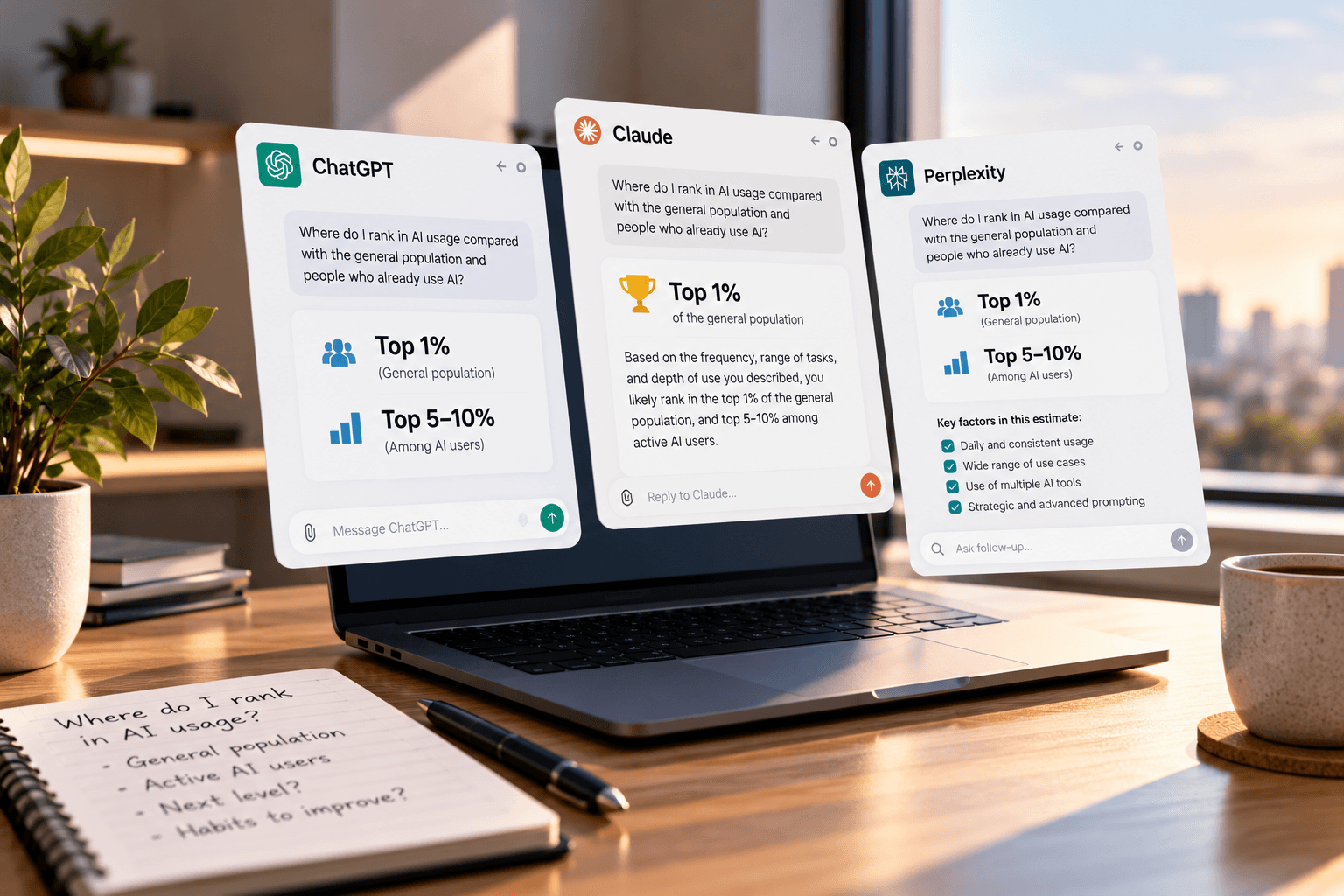
Here's a simple experiment: ask your favorite chatbot where you rank in your usage of AI.
I did exactly that. I asked Claude, and it placed me in the top 1%. ChatGPT gave me a slightly better answer, mostly because it explained its thinking. First, it also put me in the top 1% of the general population in the United States. Then it pointed out that about half the population doesn't use AI at all. Measured against people who actually use it, it put me in the top 5 to 10%.
Why the Second Answer Is More Useful
The difference between those two answers is context. "Top 1%" sounds impressive, but it depends entirely on who you're being compared with. Against everyone, you look far ahead. Against people who already use AI regularly, the gap is much smaller.
That second comparison is the one that matters for business. Your competitors who use AI aren't in the half that never touches it. They're in the group you're actually racing against.
How to Run the Test Yourself
It takes about two minutes. Open your favorite chatbot and try a prompt like this:
I use AI for [the tasks you use it for]. I use it about [how often]. The tools I use are [your tools]. Where do I rank in AI usage compared with the general population, and compared with people who already use AI? Explain your reasoning, and ask me any questions you need before answering.
That last line matters. Letting the chatbot ask you questions first, instead of guessing, gets you a more grounded answer.
Then ask two follow-ups: what does the next level of AI use look like, and what are the two or three habits that would get me there fastest?
Read the Answer With a Grain of Salt
This is a conversation starter, not a measurement. A chatbot can't see how everyone else uses AI. It's estimating from what you tell it, and chatbots tend to be encouraging, so a flattering result isn't proof. Different tools will also give you different answers, as my own two did.
The real value isn't the percentile. It's the follow-up: seeing where your gaps are and what to try next.
What This Means for Owner-Led Businesses
If you run a team, think about how widely this varies inside one company. In most healthcare, construction, and professional services businesses, one person is using AI daily while another has barely opened it. Rolling out tools without knowing where each person starts usually means some people are lost and others are bored.
Starting from where people actually are makes adoption far smoother. It also shows you where AI Automations can take repetitive work off your team's plate, so everyone's time goes to the work that needs a human.
Want to know where your team really stands with AI? Book an AI Level-Up Session and we'll find your starting point and the fastest way to level up.
FAQ
How can I find out where I rank in AI usage? Ask your favorite chatbot, giving it details about how often you use AI, what tasks you use it for, and which tools you use. Ask it to explain its reasoning and to compare you with both the general population and with people who already use AI.
Are chatbot rankings of AI usage accurate? Treat them as rough estimates. A chatbot can't see everyone's usage data, it relies on what you tell it, and it tends to be encouraging. Use the result as a starting point for improvement, not as a score.
Why does the comparison group matter? Ranking against the general population makes almost any regular AI user look advanced. Ranking against people who already use AI gives a more realistic picture of where you stand.
What should I do after getting my ranking? Ask the chatbot what the next level of AI use looks like and which habits would get you there fastest, then try one or two of them over the next week.