
A Simple Way to Think About Where You Are With AI
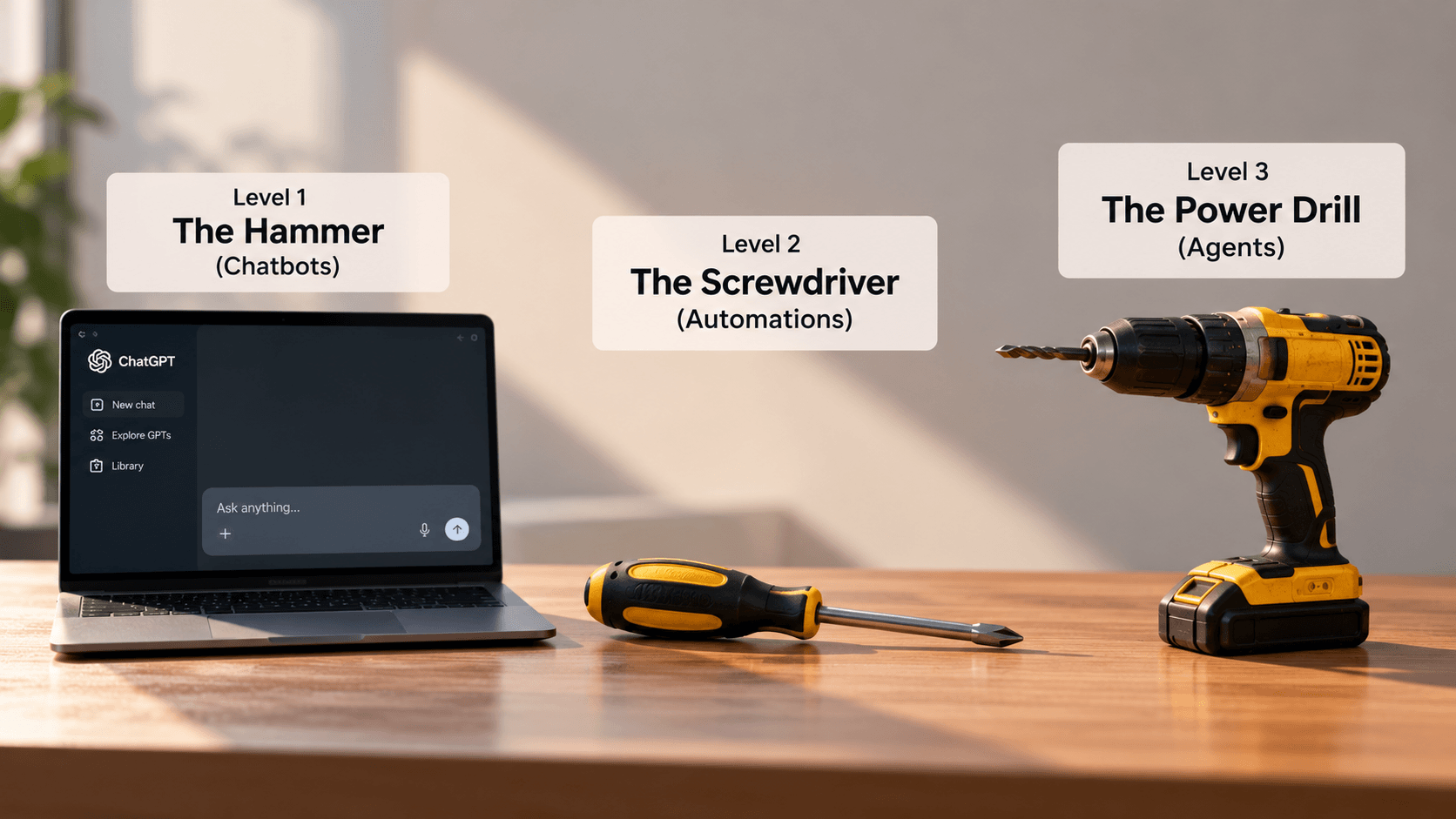
There are three levels of AI you need to be aware of, and the easiest way to understand them is with a simple analogy: the hammer, the screwdriver, and the power drill.
Level 1: The Hammer (Chatbots)
Most of us start out using AI like a hammer. This is ChatGPT, Claude, and Gemini: you ask a question and get a response. It's a bit like driving a nail in. It works, and it's a good place to begin, but every result depends on you swinging the tool yourself.
If you're at this level, an AI Level-Up Session is built to help you get more out of it and see what comes next.
Level 2: The Screwdriver (Automations)
One step up from the hammer is automation. You set an automation to run, and it starts to do things for you. You're still in the loop, but things are happening faster and more smoothly.
Think of it as a screwdriver. For attaching things, a screwdriver works better than a hammer. For example, an automation might sort incoming emails, log a new client's details, or send a follow-up message once a form is submitted. This is where AI Automations come in.
Level 3: The Power Drill (Agents)
Level three is the power drill, and this is where agents come in. Agents run automatically. You're still controlling the tool, but you're not putting all the effort into it. The agent does the effort while you stay in control and watch the events unfold. The screws go in faster, and that's what you want.
You want to be getting to this level and starting to use agents to do the heavy lifting for you, just as you would with a power drill.
A word of caution from us: being in control matters. Start with lower-risk tasks, check the results regularly, and keep a person responsible for the outcome.
How to Move Up a Level
You don't have to jump straight to agents. A sensible path looks like this:
- Notice where your time goes. Find the tasks you repeat every week.
- Pick one repetitive task. Choose something simple and low risk.
- Automate it first. Get comfortable with a tool that runs on its own while you stay in the loop.
- Then consider an agent. Once the process is clear and reliable, an agent can take over more of the work.
The chatbot doesn't go away. A hammer is still the right tool for some jobs. The goal is to stop using it for everything.
What This Means for Owner-Led Businesses
In most healthcare, construction, and professional services businesses, AI use sits at level one. People ask a chatbot questions, copy the answers, and do the rest by hand. That helps, but the real gains in time and cost come from moving up the levels, where work gets done for your team instead of just suggested to them.
Moving up also takes some of the strain off your people. When an agent puts in the effort, your team can focus on judgment and decisions rather than driving every task by hand.
Wondering which level your business is at, and what to tackle first? Book an AI Level-Up Session and we'll show you where you are and the fastest way to move up.
FAQ
What are the three levels of AI? Level one is chatbots like ChatGPT, Claude, and Gemini, where you ask questions and get responses. Level two is automations that run tasks while you stay in the loop. Level three is agents that do much of the work on their own while you stay in control.
What's the difference between an automation and an AI agent? An automation runs a task you've set up, and you remain closely involved. An agent works more independently, putting in the effort itself while you supervise and stay in control.
Do I need to stop using chatbots to move up a level? No. Chatbots are still useful for many jobs. The idea is to use the right tool for each task and not rely on a chatbot for everything.
How do I keep control when using AI agents? Start with lower-risk tasks, review the results regularly, and keep a person accountable for the outcome. Expand what the agent handles only as you build confidence.