
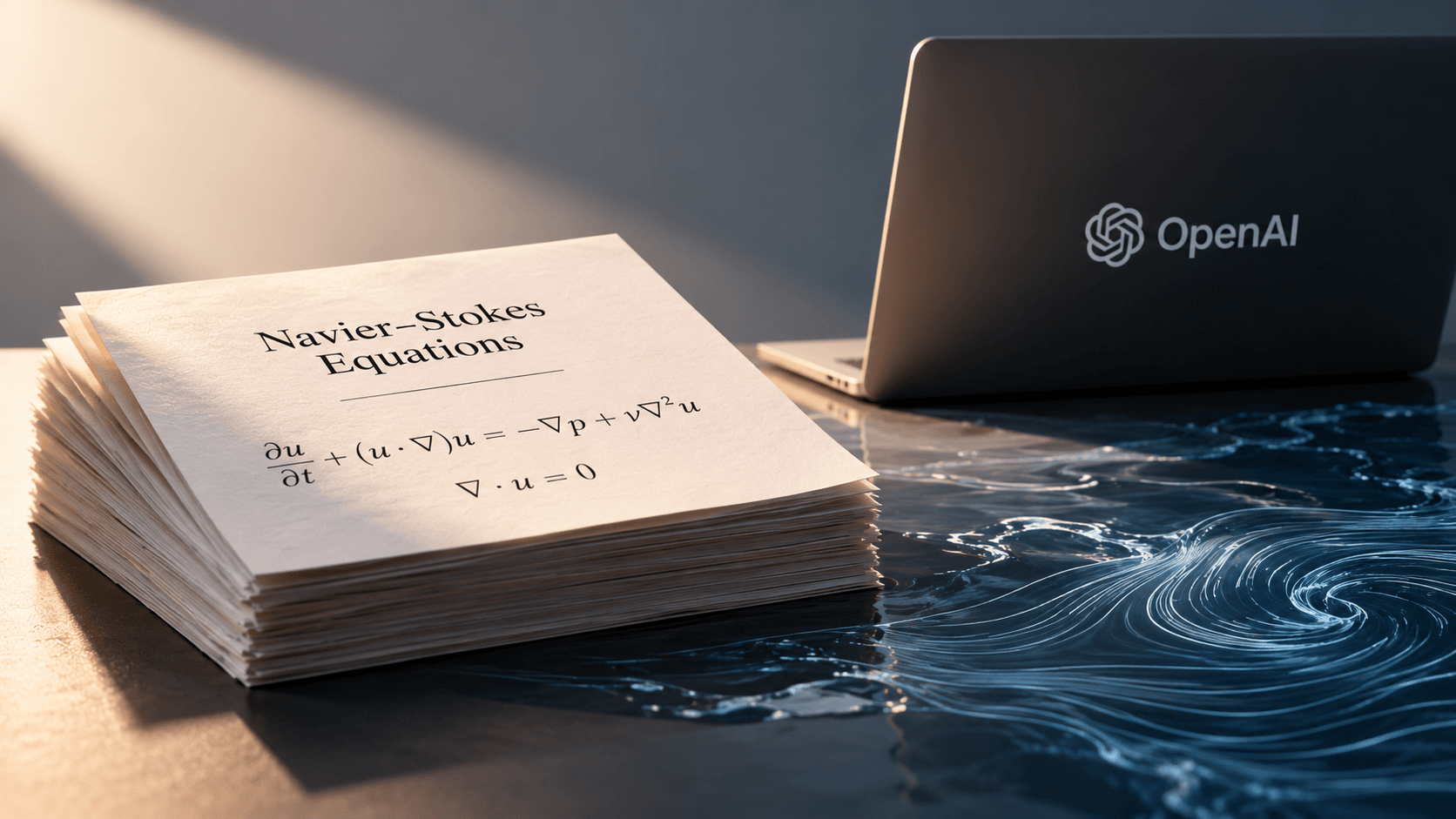
What OpenAI Says Its AI Agents Just Did
In early September 2026, OpenAI announced that a system of roughly 10,000 coordinating AI agents, running an unreleased model, had produced a proof connected to the Navier-Stokes problem. It's one of the seven Millennium Prize Problems, each carrying a $1 million prize from the Clay Mathematics Institute, and it has resisted mathematicians for roughly 90 years.
The Navier-Stokes equations describe how fluids like air and water move. The open question is whether a smooth flow can always stay smooth, or whether it can break down. OpenAI claims its agents found a case where it does, with the flow developing a singularity in finite time.
According to OpenAI, the agents worked for about 88 hours. A second AI model then spent roughly 17 more hours formalizing the result in Lean, a language that lets computers check proofs step by step.
So, Is It Actually Solved?
Not yet confirmed. OpenAI has said it doesn't intend to claim the prize, and the claim hasn't been independently verified by the wider mathematical community. The Clay Institute doesn't consider proposed solutions until at least two years after publication.
There's also a dispute. Two mathematicians were working on a related problem, and questions have been raised about credit and about whether OpenAI's result matches the official problem statement. It's best to treat this as a major claim under review, not a settled breakthrough.
Why Should a Business Owner Care?
You don't need to follow the mathematics to take three useful lessons from this.
Agents can work at a scale people can't. Thousands of agents coordinating for days is a very different kind of capacity from one person typing into a chatbot. This is the "power drill" level of AI, where agents do the heavy lifting and people stay in control.
Checking the work matters. OpenAI didn't just trust its agents. It had the result formally checked. That's a lesson for any business using AI: build a verification step into anything important, whether that's a person reviewing the output or an automated check.
Be careful with the hype. This used an unreleased model and reportedly cost millions of dollars in computing power. It shows where the technology is heading, but it isn't what's available to your business today.
What This Means for Owner-Led Businesses
You don't need 10,000 agents. For healthcare, construction, and professional services businesses, the gains come from a small number of well-designed agents handling repeat work such as scheduling, reporting, intake, and follow-ups, with a person checking the results.
That's the practical end of this story, and it's what AI Automations are built to do: take the repetitive work off your team and keep a human in control of the outcome.
Want to see what agents could do for your business today? Book an AI Level-Up Session and we'll find the tasks where AI pays off fastest.
FAQ
Did OpenAI solve the Navier-Stokes problem? OpenAI says its AI agents produced a proof that a fluid flow can develop a singularity in finite time. The result hasn't been independently verified, mathematicians are still examining it, and the $1 million prize has not been awarded.
What are the Millennium Prize Problems? They are seven famously difficult math problems set by the Clay Mathematics Institute in 2000, each with a $1 million prize. Only one, the Poincaré conjecture, has been solved.
How many AI agents were involved and how long did it take? OpenAI says about 10,000 coordinating agents worked for roughly 88 hours, followed by around 17 more hours for another AI model to formalize the result in Lean.
Can businesses use this kind of AI today? Not this specific model, which is unreleased. But AI agents and automations are available now at a smaller scale, and they can already take on repetitive business tasks with a person overseeing the results.