
Everyone's an AI Expert Now... Or Are They?
Artificial intelligence has quickly become the hottest topic in business. Everywhere you look, people are sharing AI-generated images, creating viral memes, or demonstrating the latest AI chatbot. As a result, there is a growing perception that becoming proficient with AI is easy.
Create a few images in ChatGPT and suddenly you're an AI expert.
Unfortunately, many small and medium-sized businesses are discovering the hard way that successful AI adoption requires far more than knowing how to use a chatbot.
Across industries, AI projects are failing—not because the technology is incapable, but because organizations are implementing AI without first understanding how their business actually works.
AI Is a Tool, Not a Strategy
One of the biggest misconceptions surrounding artificial intelligence is that AI itself is the solution.
It isn't.
AI is simply another business tool, much like accounting software, a CRM system, or an ERP platform. The value doesn't come from the tool itself; it comes from how effectively it is integrated into your business processes.
Business owners don't invest in AI because they want AI.
They invest in AI because they want:
- Higher profits
- Lower operating costs
- Faster decision-making
- Improved customer service
- Greater operational efficiency
- More time to focus on growth
The businesses achieving meaningful results with AI understand this distinction. They begin by identifying business outcomes and then determine where AI can support those objectives.
Why Many AI Implementations Fail
At Skillion AI Labs, we frequently see organizations rush to deploy AI tools before addressing foundational business challenges.
The most common issue?
Poor data quality.
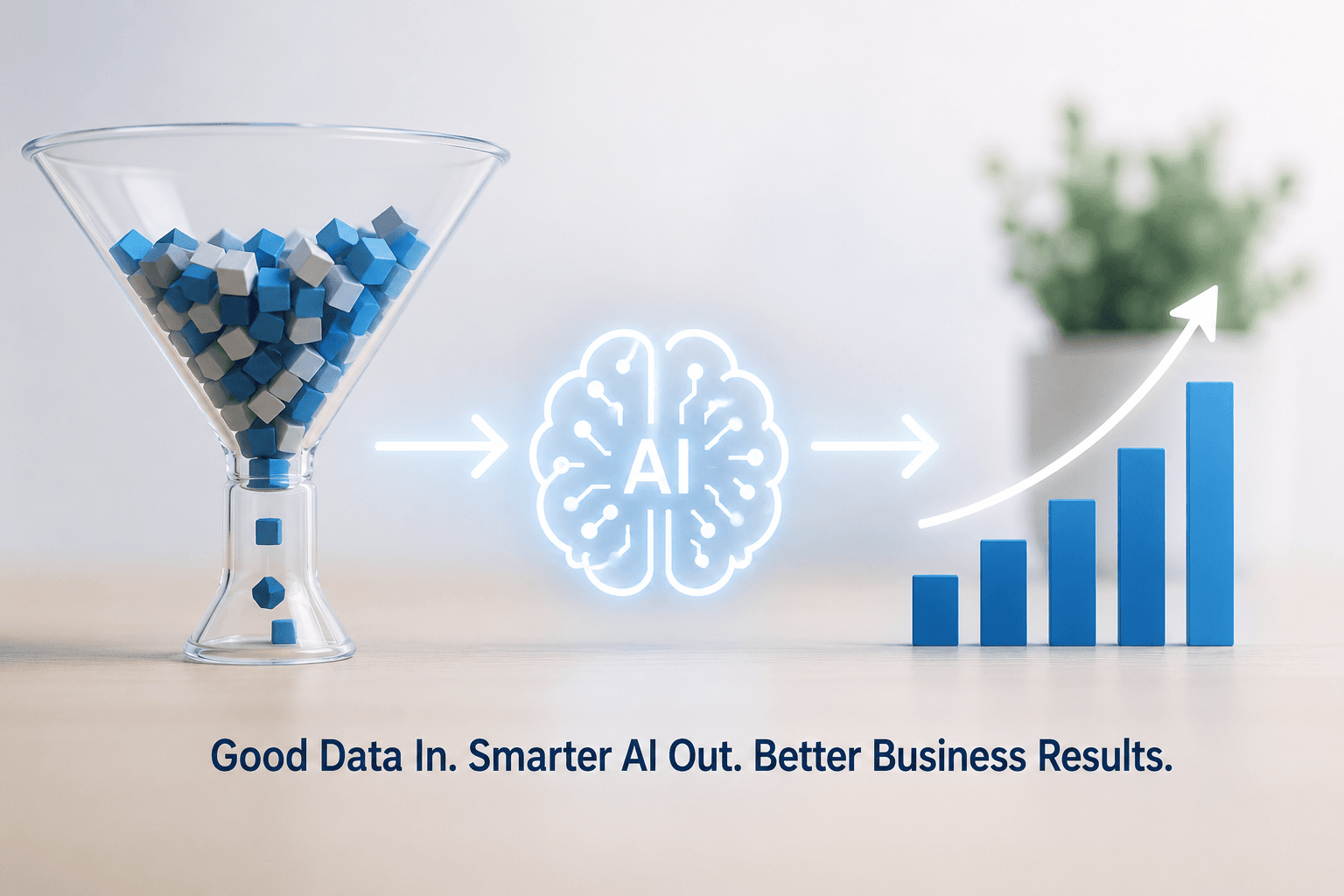
Many business leaders assume that AI will magically solve operational problems. However, AI can only work with the information it receives.
If your data is incomplete, inaccurate, duplicated, inconsistent, or spread across multiple disconnected systems, AI will simply amplify those problems.
This is often summarized by a simple principle:
Garbage in, garbage out.
The more sophisticated the AI system becomes, the more important clean and reliable data becomes.
Clean Data Creates Competitive Advantage
For owner-led businesses with between 5 and 50 employees, data quality is often overlooked because day-to-day operations take priority.
However, organizations that invest in data hygiene create a significant advantage when implementing AI.
Examples include:
Healthcare Practices
Healthcare providers often store information across multiple systems, including practice management platforms, billing software, scheduling tools, and electronic medical records.
Without consistent and accurate data, AI-powered automation, ambient documentation, revenue cycle management, and patient communication systems can produce unreliable outcomes.
Construction Companies
Construction firms frequently manage data across spreadsheets, project management systems, equipment tracking platforms, and financial software.
When project data is inconsistent, AI cannot accurately identify delays, predict resource requirements, or provide meaningful operational insights.
Professional Services Firms
Consultancies, engineering firms, accountants, and legal practices depend heavily on client information and knowledge management.
If client records, project information, and internal documentation are poorly maintained, AI tools will struggle to deliver accurate recommendations or automate workflows effectively.
Before You Implement AI, Ask These Questions
Before investing in any AI initiative, business leaders should evaluate three critical areas:
1. Is Our Data Clean?
Can you trust the information inside your systems?
Are duplicate records removed?
Are staff following consistent data entry processes?
2. Is Our Data Consistent?
Do different systems use the same customer names, project identifiers, service codes, and reporting structures?
Can information flow seamlessly between systems?
3. Do We Understand Our Current Processes?
Have your key workflows been documented?
Do you know where delays, bottlenecks, errors, and manual work occur?
Without process visibility, AI often automates inefficiency rather than eliminating it.
AI Success Starts Long Before the Technology
The businesses seeing the greatest return on AI investments are not necessarily the ones using the newest tools.
They are the organizations that have invested time understanding their operations, cleaning their data, and creating a solid foundation for automation.
AI can deliver extraordinary leverage. It can help businesses compete against larger organizations, reduce administrative overhead, improve customer experiences, and unlock entirely new opportunities.
But only when implemented thoughtfully.
How Skillion AI Labs Helps Businesses Adopt AI Successfully
At Skillion AI Labs, we help established small and medium-sized businesses identify practical opportunities for AI adoption that deliver measurable business outcomes.
Rather than starting with technology, we start with your business:
- Understanding your workflows
- Evaluating data quality
- Identifying high-value opportunities
- Reducing operational inefficiencies
- Implementing practical AI solutions
- Supporting change management and adoption
Our clients are typically owner-led businesses with 5 to 50 employees and annual revenues between approximately $600,000 and $20 million who want to remain competitive in an increasingly AI-driven economy.
Because in the end, AI is not the goal.
Better business performance is.
And that starts with getting the fundamentals right.