
Why Most AI Projects Fail: The Critical Step Businesses Keep Skipping
Artificial Intelligence promises increased productivity, lower operating costs, and a competitive advantage. Yet many business leaders are finding themselves frustrated after implementing AI tools that fail to deliver meaningful results.
Recently, I spoke with a sales professional in Poland who expressed exactly this frustration. Her company had introduced AI into their workflows, but instead of making her job easier, it was creating additional complexity and getting in the way of how she worked. Unfortunately, this story is becoming increasingly common.
The problem isn't AI itself.
The problem is how businesses are implementing it.
AI Is Not a Strategy
One of the biggest mistakes companies make is treating AI as a standalone initiative.
Leadership teams decide they "need AI," purchase a few tools, roll out ChatGPT or another large language model, and expect immediate improvements across the business.
When the results fail to materialize, AI gets blamed.
In reality, the issue is that AI was introduced without understanding where it fits within existing business processes.
Artificial intelligence should be viewed like any other business tool. Before implementation, organizations need to understand:
- What problem are we trying to solve?
- Which workflow are we trying to improve?
- What outcome are we trying to achieve?
- How will success be measured?
Without answering these questions first, AI often becomes another layer of complexity rather than a source of value.
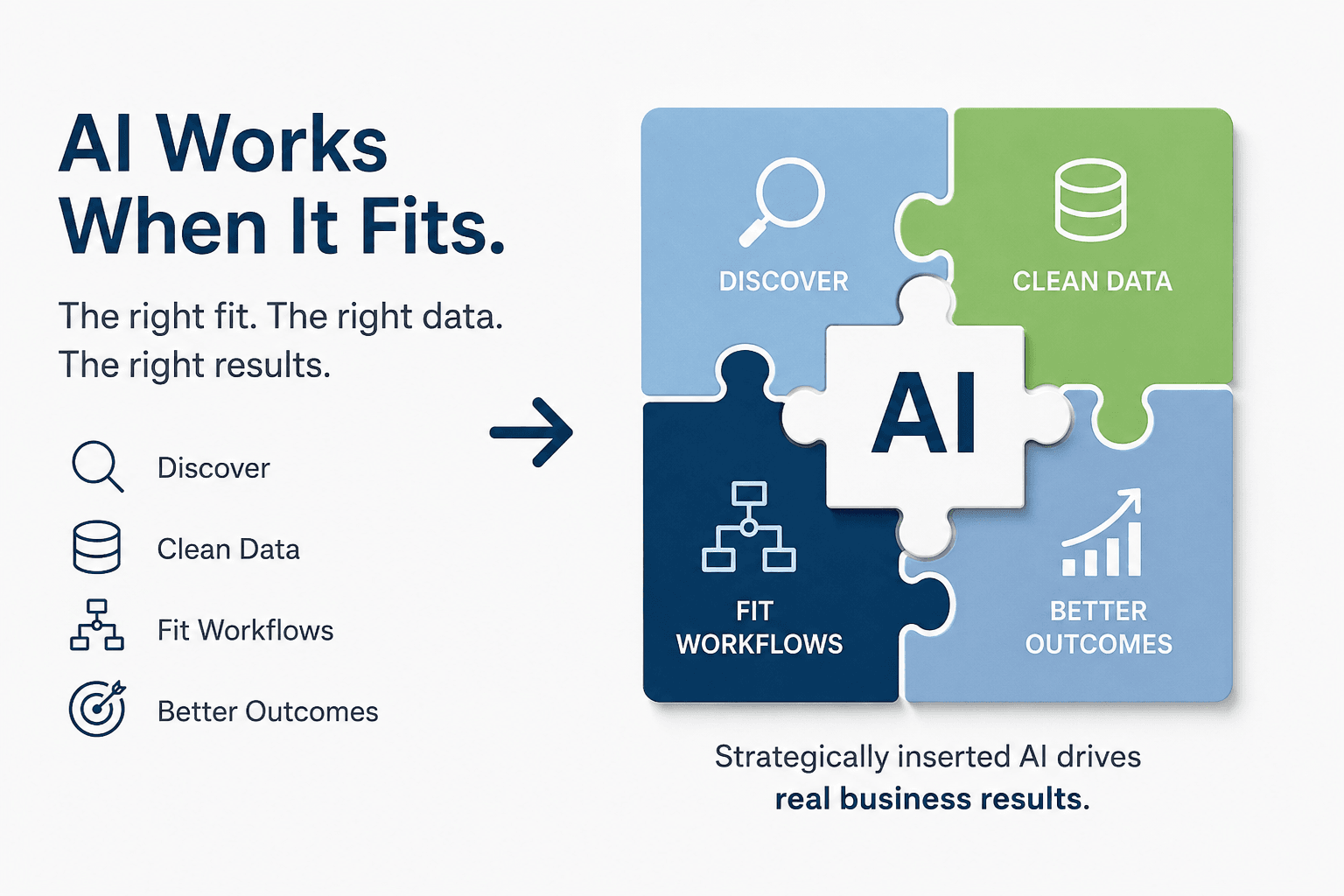
Start with Discovery, Not Technology
At Skillion AI Labs , we encourage businesses to begin with analysis and discovery before selecting AI solutions.
This means taking the time to understand:
- Current business processes
- Existing bottlenecks
- Repetitive administrative tasks
- Data quality issues
- Employee workflows
- Customer experience challenges
Only after these areas have been mapped should AI be considered.
The objective is not to "do AI."
The objective is to improve business outcomes.
For some companies, that may mean reducing administrative workload. For others, it could mean increasing revenue, improving customer response times, accelerating project delivery, or reducing operational costs.
The technology comes second.
Clean Data Is Non-Negotiable
AI systems are only as effective as the information they receive.
Many organizations attempt to automate processes using AI while operating with inconsistent, incomplete, or poorly structured data.
This creates predictable problems:
- Inaccurate outputs
- Poor recommendations
- Workflow failures
- Low employee confidence in AI systems
Before introducing AI, businesses should evaluate:
- Data accuracy
- Data consistency across systems
- Duplicate records
- Missing information
- Integration between platforms
Improving data quality often delivers significant business value even before AI is introduced.
AI Must Fit Existing Workflows
Successful AI adoption requires one of two things:
- AI must integrate naturally into existing workflows.
- Existing workflows must be redesigned to take advantage of AI.
What rarely works is forcing employees to use AI tools that don't align with how they perform their jobs.
This is especially important for small and medium-sized businesses where teams are already stretched thin and operational efficiency is critical.
Business owners should carefully evaluate where AI can remove friction rather than create it.
The best AI implementations are often the least noticeable. Employees simply find themselves completing work faster, making fewer mistakes, and spending more time on higher-value activities.
Why This Matters for Small and Medium Businesses
Large enterprises are investing billions of dollars into AI transformation. These organizations have dedicated teams, substantial budgets, and the resources to experiment.
Small and medium-sized businesses do not have that luxury.
For owner-led companies with between 5 and 50 employees, every technology investment must generate measurable returns.
This is why strategic AI adoption is so important.
Businesses that successfully implement AI can:
- Reduce administrative overhead
- Improve employee productivity
- Increase customer responsiveness
- Lower operational costs
- Make better decisions using data
- Remain competitive against larger organizations
Those that rush into AI without a clear strategy often experience frustration, wasted investment, and poor adoption.
The Skillion AI Labs Approach
At Skillion AI Labs, we help healthcare providers, construction companies, and professional service firms identify where AI can create measurable business value.
Rather than starting with technology, we begin with business outcomes.
We analyze workflows, assess data quality, identify bottlenecks, and uncover opportunities where automation and artificial intelligence can improve profitability and efficiency.
Only then do we recommend AI solutions that fit the business.
Because AI is not the goal.
Increased revenue, lower costs, better decision-making, and more time for business owners to focus on growth—that is the goal.
The companies that approach AI strategically will gain a significant competitive advantage over the next decade.
The companies that simply "add AI" without a plan may find themselves wondering why the promised benefits never arrived.