
Why Retrieval Augmented Generation (RAG) Still Hallucinates—And How Smart Businesses Can Prevent It
Artificial intelligence has transformed how businesses access and use information. One of the most powerful technologies driving this transformation is Retrieval Augmented Generation (RAG), which allows Large Language Models (LLMs) to answer questions using your company's own documents instead of relying solely on their general training.
For healthcare providers, construction companies, and professional service firms, RAG can unlock the value hidden inside operating procedures, contracts, project documentation, policies, and technical manuals.
However, many business leaders assume that implementing a RAG system completely eliminates AI hallucinations.
Unfortunately, that's not always the case.
What Is Retrieval Augmented Generation (RAG)?
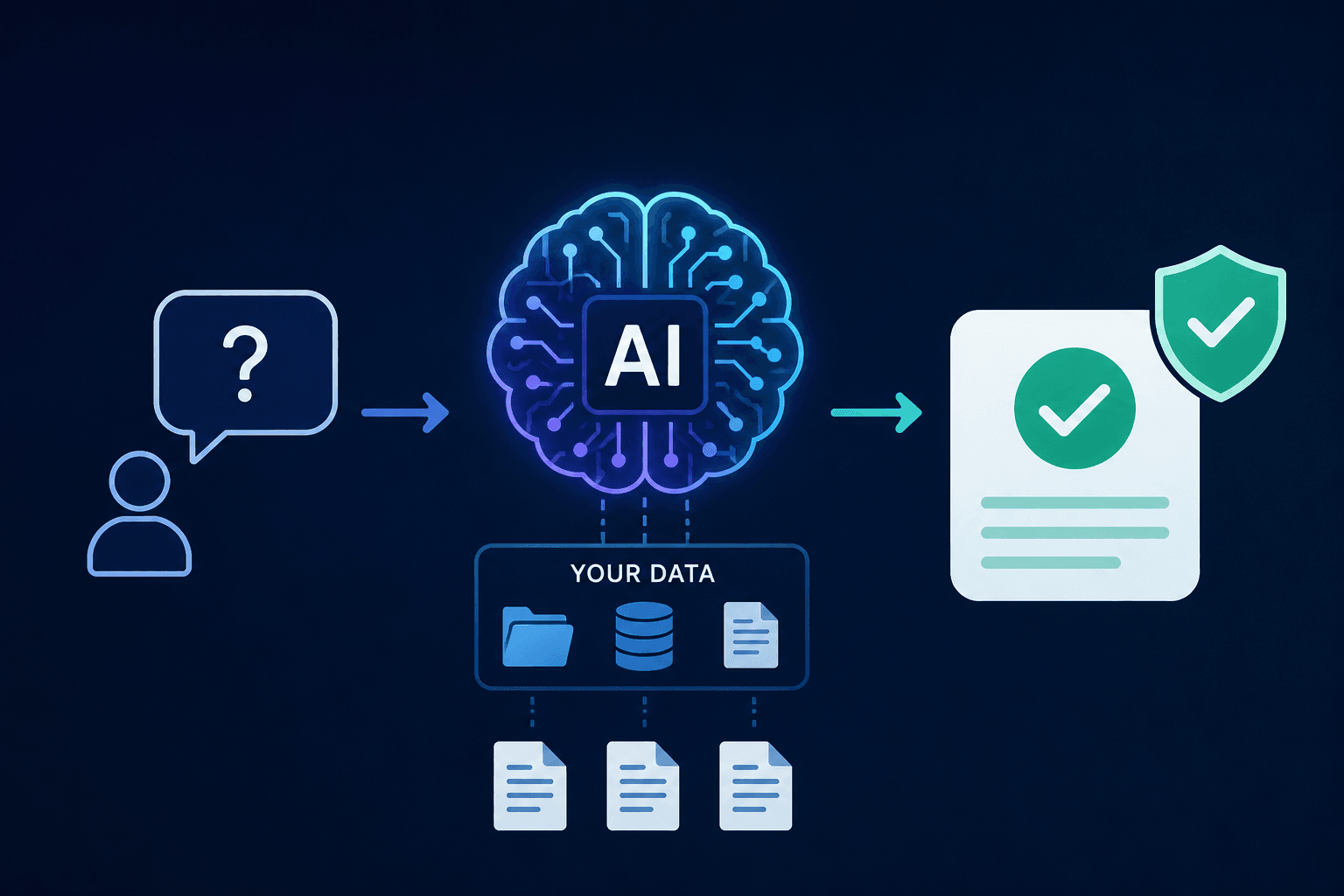
Retrieval Augmented Generation (RAG) combines two technologies:
- A knowledge store containing your organization's documents, files, databases, or internal information.
- A Large Language Model (LLM) that retrieves relevant information from that knowledge base before generating its response.
Instead of relying purely on what the AI learned during training, it searches your organization's approved information first.
This dramatically improves accuracy and makes AI suitable for many business applications, including:
- Internal knowledge assistants
- Customer support
- Technical documentation
- Standard operating procedures
- HR policy guidance
- Compliance documentation
- Construction project documentation
- Healthcare administrative workflows
For many SMBs, RAG represents one of the fastest ways to deploy practical AI that delivers measurable business value.
So Why Does a RAG System Still Hallucinate?
The simple answer is this:
Large Language Models are designed to produce helpful answers—even when they don't actually know the answer.
If the retrieved information doesn't fully answer the question, or if the prompt isn't carefully controlled, the model may attempt to "fill in the gaps."
This behaviour is known as an AI hallucination.
Instead of saying:
"I don't have enough information to answer that."
The AI may generate something that sounds plausible but isn't actually supported by your documentation.
This is one of the biggest risks when businesses deploy AI without appropriate safeguards.
Why This Matters for Small and Medium Businesses
An incorrect answer isn't always harmless.
Depending on your industry, hallucinations can lead to:
- Incorrect customer advice
- Compliance issues
- Operational mistakes
- Poor business decisions
- Loss of trust in AI systems
- Increased support costs
For healthcare organizations, inaccurate information can create administrative and regulatory problems.
For construction companies, incorrect procedures or outdated specifications can lead to expensive project errors.
For professional services firms, inaccurate client information can damage credibility and client relationships.
Simply installing a RAG solution isn't enough—you also need to ensure it behaves reliably.
How to Reduce AI Hallucinations
The good news is that hallucinations can often be significantly reduced through thoughtful system design.
Rather than allowing the language model to answer freely, developers can introduce programmatic rules that govern how responses are generated.
Examples include:
- Only answering questions supported by retrieved documents.
- Requiring evidence or document citations before responding.
- Returning "I don't know" when confidence is low.
- Preventing the AI from inventing missing information.
- Using confidence thresholds before generating answers.
- Validating responses against multiple data sources.
These safeguards don't eliminate hallucinations entirely, but they dramatically improve the reliability of business AI systems.
The Long Tail of AI Implementation
Many organizations assume that building a RAG solution is the hard part.
In reality, creating the initial system is often only the beginning.
The real effort comes in refining:
- Prompt engineering
- Response validation
- Guardrails
- Business rules
- Data quality
- Testing edge cases
- User feedback
- Ongoing monitoring
This refinement process is often called the long tail of AI implementation.
It's where successful AI projects distinguish themselves from disappointing ones.
Practical AI Is About Business Outcomes
At Skillion AI Labs, we don't measure AI success by how advanced the technology looks.
We measure it by business outcomes.
For owner-led businesses with between 5 and 50 employees and annual revenues from $600,000 to $20 million, AI should deliver measurable improvements such as:
- Lower operating costs
- Faster decision-making
- Reduced administrative workload
- Better customer experiences
- Increased productivity
- More time for owners to focus on growth
Retrieval Augmented Generation is a powerful capability, but it delivers real value only when paired with strong governance, high-quality data, and carefully designed business processes.
Final Thoughts
Retrieval Augmented Generation is one of the most practical ways for SMBs to deploy AI using their own knowledge and documentation. However, businesses should not assume that RAG completely eliminates AI hallucinations.
Large Language Models naturally try to be helpful, and without the right controls they may still generate answers that extend beyond the information you've provided.
The businesses that gain the greatest competitive advantage from AI are not necessarily those using the newest technology—they are the ones implementing it with the right guardrails, governance, and business processes from the outset.
At Skillion AI Labs, we help healthcare, construction, and professional services businesses implement AI solutions that are practical, reliable, and focused on measurable business outcomes—not technology for technology's sake.