
AI's Hidden Cost: Why Energy Consumption Will Shape the Future of Artificial Intelligence
Artificial intelligence is transforming business at an extraordinary pace. Every week, new AI tools promise greater productivity, faster decision-making, and lower operating costs. But behind this technological revolution lies a challenge that many business owners have not yet considered: energy consumption.
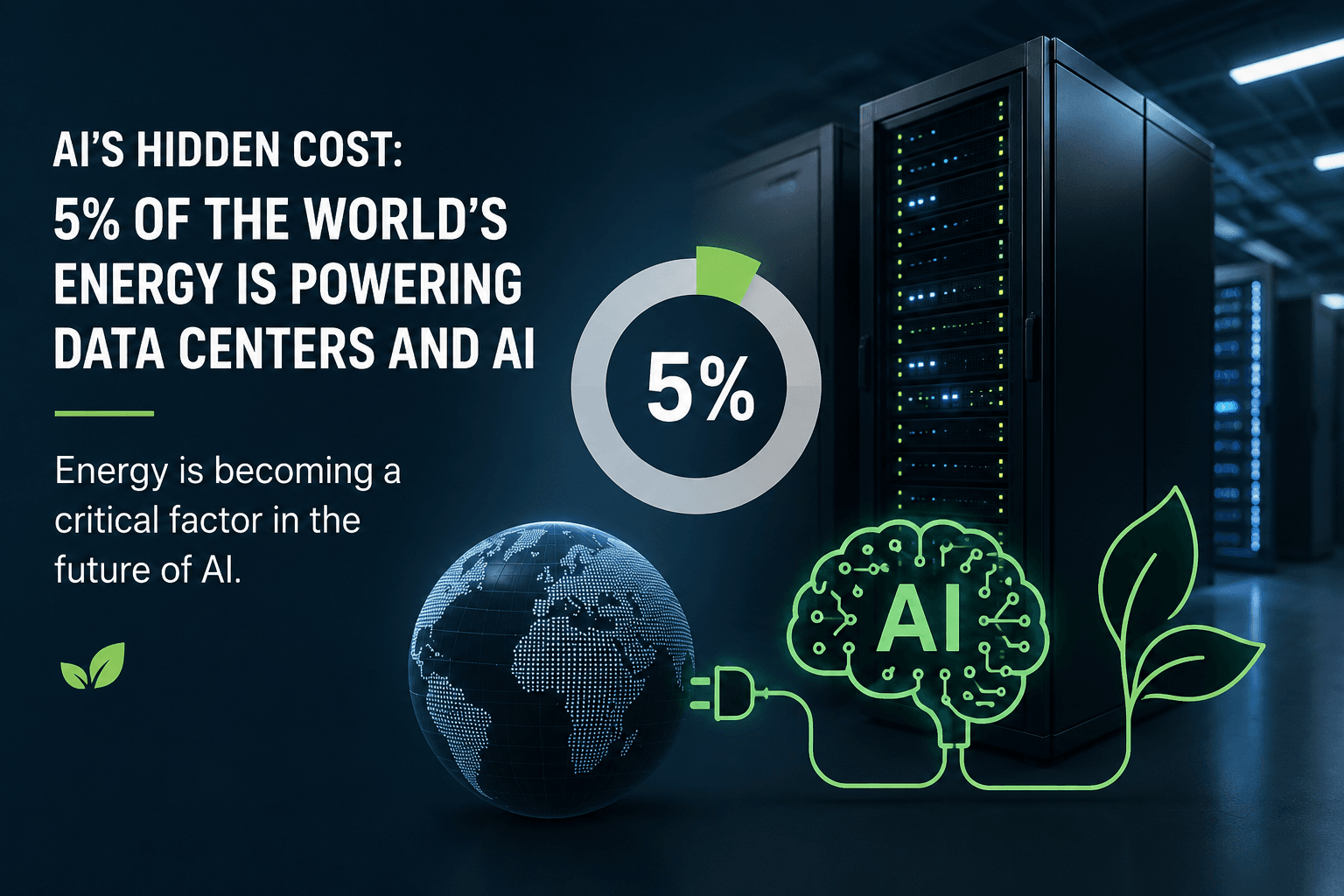
Today, approximately 5% of the world's electricity is consumed by data centers and AI-related computing. While that figure may seem surprising, it highlights an important reality—AI is not only changing the way businesses operate, it is changing global infrastructure.
For small and medium-sized businesses, understanding this trend can help shape smarter AI investment decisions over the coming years.
AI Requires More Than Software
When most business owners think about AI, they imagine software like ChatGPT, Microsoft Copilot, or industry-specific automation platforms.
What they don't see are the enormous data centers operating behind the scenes.
Every AI prompt, document analysis, image generation, and automated workflow requires powerful servers running around the clock. These facilities consume vast amounts of electricity for both computing and cooling.
As AI adoption accelerates across every industry, so too does demand for energy.
Why Energy Costs Matter
In North America, businesses may not yet feel the full impact because electricity remains relatively affordable compared to many other regions.
However, in Europe, where energy prices are significantly higher, businesses are already seeing increased operating costs driven by growing electricity demand.
Even in the United States, many organizations have noticed gradual increases in energy bills as demand continues to rise.
The important takeaway is that AI isn't just a software trend—it is becoming an infrastructure challenge.
AI Will Continue to Increase Energy Demand
There is little evidence that AI adoption is slowing.
Large technology companies continue investing hundreds of billions of dollars into:
- New AI data centers
- Specialized AI processors
- Cloud infrastructure
- Renewable energy projects
- Nuclear and alternative power generation
The reason is simple.
Demand for AI continues to grow faster than available computing capacity.
As more businesses integrate AI into everyday operations, the pressure on electrical grids will only increase.
What This Means for Small and Medium Businesses
This doesn't mean businesses should avoid AI.
Quite the opposite.
Organizations that delay AI adoption risk falling behind larger competitors that are already improving productivity and lowering operational costs.
The smarter strategy is to adopt AI thoughtfully and efficiently.
Rather than deploying AI everywhere, focus on high-value opportunities that deliver measurable business outcomes while minimizing unnecessary processing and costs.
Examples include:
- Automating repetitive administrative work
- Improving customer response times
- Streamlining document processing
- Enhancing reporting and business intelligence
- Supporting employees with AI assistants instead of replacing workflows
Well-designed AI implementations typically generate far greater business value than the cost of the computing resources they consume.
Efficiency Will Become a Competitive Advantage
Over the next decade, businesses will likely begin asking new questions:
- Which AI platform delivers the best return per dollar?
- Which automation provides the greatest productivity gain?
- Which models consume less computing power?
- How can AI workflows be optimized to reduce unnecessary processing?
Just as businesses learned to improve fuel efficiency and reduce waste in previous decades, AI efficiency may become another important business metric.
Organizations that use AI intelligently—not excessively—will likely achieve the strongest long-term results.
The Skillion AI Labs Perspective
At Skillion AI Labs, we believe artificial intelligence should solve business problems—not create new ones.
Our goal isn't simply to implement AI tools. We help owner-led businesses identify where AI can generate measurable improvements in profitability, reduce operational costs, improve decision-making, and free leadership teams to focus on growth.
For healthcare providers, construction companies, and professional services firms with between 5 and 50 employees, the opportunity isn't to use more AI.
It's to use the right AI, in the right processes, with a clear business outcome in mind.
As global energy demand continues to rise, organizations that combine practical AI adoption with operational efficiency will be best positioned to compete against larger, better-funded competitors.
AI is changing business.
Understanding its hidden costs will help you make better decisions for the future.