
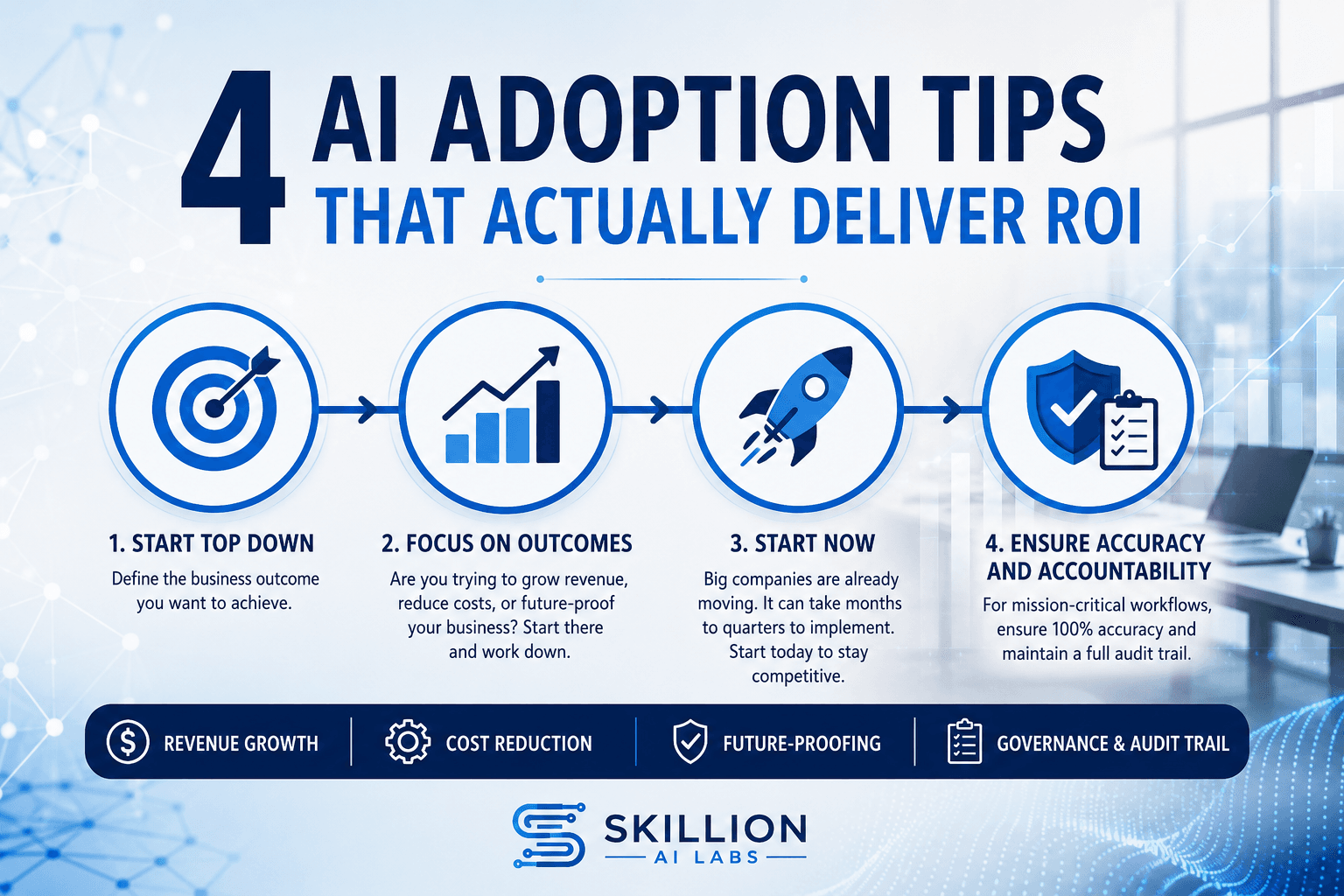
4 Critical AI Adoption Tips Most Businesses Learn Too Late
Artificial Intelligence is no longer something that businesses can afford to watch from the sidelines. Every week, new tools emerge, competitors become more efficient, and customer expectations continue to evolve.
However, many business owners make the same mistake: they expect AI to deliver transformational results simply by giving employees access to tools like ChatGPT.
Unfortunately, that's not how successful AI adoption works.
At Skillion AI Labs, we've seen that the businesses achieving the strongest AI outcomes follow a different approach. Here are four practical tips that can dramatically improve your chances of success.
1. Don't Expect ROI From Simply Installing ChatGPT
One of the biggest misconceptions about AI is that productivity gains happen automatically.
Many organisations roll out ChatGPT or another Large Language Model (LLM) across the company and expect immediate improvements. While employees may find it useful, the business often struggles to identify measurable returns.
Why?
Because AI is only one component of a broader business system.
Without defined processes, clear objectives, integrations, training, and governance, AI becomes another tool on the desktop rather than a driver of business outcomes.
The real value comes from redesigning workflows, eliminating repetitive tasks, and embedding AI into how work actually gets done.
2. Start With Business Outcomes, Not Technology
Before selecting any AI tool, ask a more important question:
What business problem are we trying to solve?
Typically, the answer falls into one of three categories:
- Increasing revenue
- Reducing operational costs
- Future-proofing the business
Starting with business outcomes creates clarity.
For example:
- If the goal is revenue growth, AI may help generate leads, improve sales follow-up, or personalise customer engagement.
- If the goal is cost reduction, AI may automate administrative work, reporting, or customer support.
- If the goal is future-proofing, AI may help build new capabilities that competitors cannot easily replicate.
The mistake many organisations make is starting with the technology and then searching for a use case.
The most successful businesses do the opposite.
3. Start Now—Waiting Is a Competitive Risk
Many business leaders are still treating AI as an initiative for next year.
That may be too late.
The reality is that implementing AI effectively takes time. Businesses need to:
- Map business processes
- Clean and organise data
- Select appropriate tools
- Train teams
- Test workflows
- Establish governance and reporting
These activities often take months, not weeks.
Meanwhile, larger competitors are investing heavily in AI transformation. They are becoming faster, more efficient, and more responsive to customers.
The businesses that start today gain a learning advantage that compounds over time.
The businesses that wait risk falling behind.
4. Protect Mission-Critical Workflows
Not every business process can tolerate errors.
If you're using AI in areas such as financial reporting, healthcare administration, compliance, legal documentation, safety systems, or operational decision-making, accuracy becomes essential.
AI should never be deployed with a "hope for the best" approach.
Instead, organisations need:
- Human oversight
- Validation processes
- Audit trails
- Exception handling
- Clear accountability
In high-stakes workflows, AI should augment decision-making, not replace governance.
A successful AI strategy balances automation with control.
The Bottom Line
AI is not a software installation project. It is a business transformation project.
The organisations seeing the greatest return on investment are not simply buying AI tools—they are aligning AI initiatives with business objectives, redesigning workflows, ensuring quality controls, and starting before their competitors do.
At Skillion AI Labs, we help businesses identify where AI can create measurable impact, whether that means increasing revenue, reducing costs, improving efficiency, or preparing for future disruption.
The businesses that approach AI strategically will build a significant competitive advantage over the next decade.
The question is not whether AI will change your industry.
The question is whether your business will be ready when it does.